
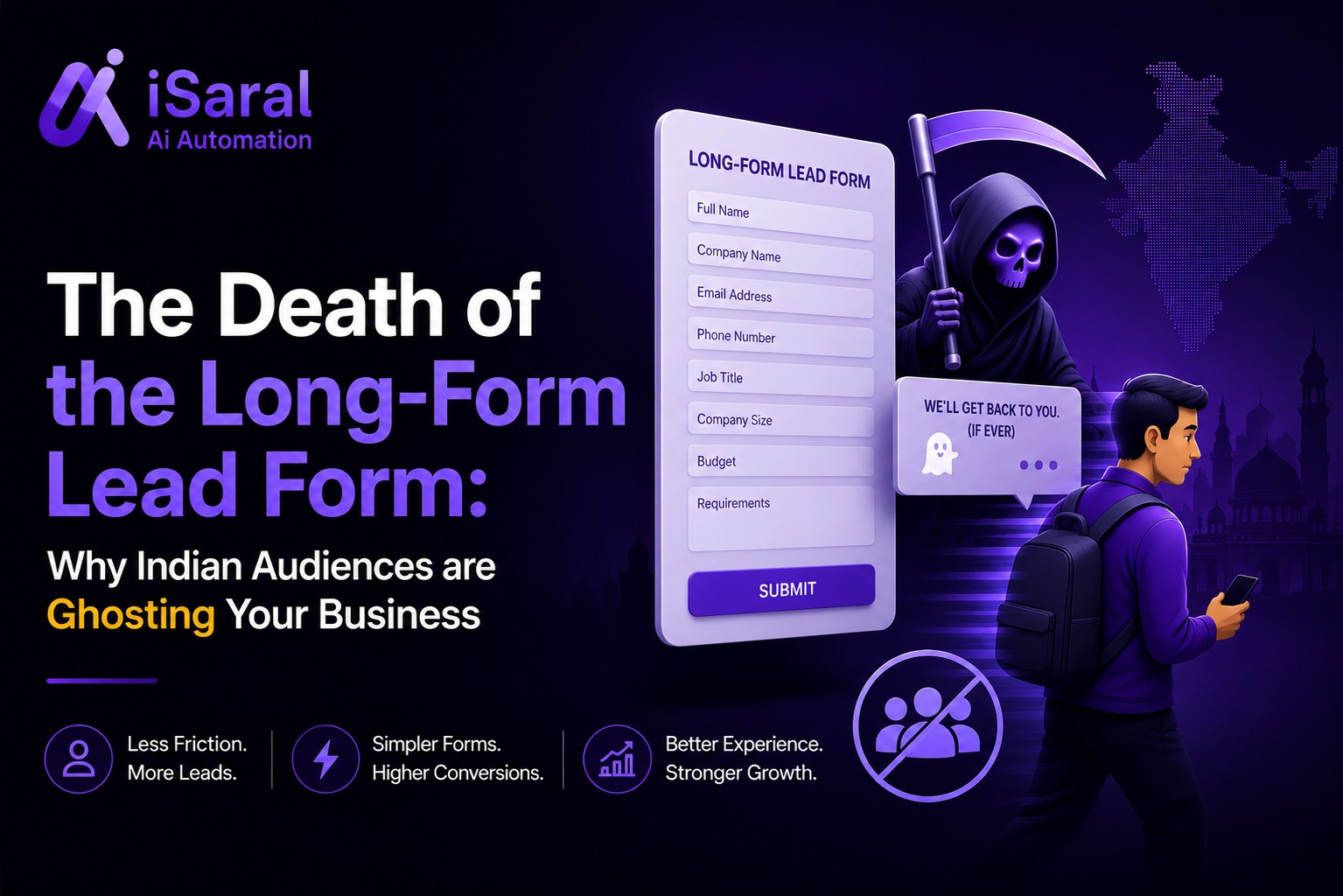
If you're watching your digital leads dry up despite expensive ads and precision targeting, the problem likely isn't your product—it's your front door. In the fast-paced Indian digital landscape, long lead forms are where conversions go to die.
The era of the patient digital consumer is over. Today, an Indian user's attention is the most expensive commodity you're bidding for. When you ask a potential lead to navigate a maze of ten mandatory fields just to get a quote or a demo, you aren't just asking for data; you're imposing a "friction tax" that most are simply unwilling to pay.
It's not your targeting. It's not your ad creative. It's the moment of truth when your prospect lands on your page and sees a wall of form fields. That's when the ghosting happens.
The Friction Tax: Why Traditional Forms Fail in India
When the Effort Exceeds the Perceived Value
Digital marketing in India has undergone a seismic shift. The traditional Western playbook—capturing name, email, company size, budget, and job title upfront—is hitting a wall of "form fatigue." Indian users are ditching eight-field forms at alarming rates.
They click your high-performing ad, land on your page, see the wall of input fields, and ghost. No second thoughts, no "save for later," just a swift exit to a competitor who makes life easier.
This failure isn't just about length; it's about perceived value. In a market flooded with options, the user asks: "Is the information I'm about to get worth the five minutes of effort I'm about to put in?" More often than not, the answer is a resounding no.
We are seeing a psychological shift where Indian consumers prioritize immediate gratification and low-effort interactions over formal business processes. The user experience has trained them to expect simplicity—and forms feel like the opposite.
Inside the Mind of the Indian Digital User
Understanding Unique Behavioral Nuances
To fix your lead gen, you have to understand the unique behavioral nuances and psychological evolution of the Indian market. It's no longer just about being online; it's about how the audience breathes and moves through the digital space.
| User Behavior | Traditional Approach | Modern Reality |
|---|---|---|
| Device Preference | Desktop-first forms | Mobile-only, often on-the-go |
| Communication Style | Formal questionnaires | Conversational, chat-based |
| Trust Baseline | Assume benefit of doubt | Earned skepticism & privacy concerns |
| Expected Response Time | 24-48 hours for follow-up | Immediate acknowledgment needed |
| Data Sharing | Upfront personal details | Only after proving value |
Mobile-First (and Mobile-Only)
Thumb-Friendly Is Non-Negotiable
The vast majority of Indian users access the internet via smartphones, often on the move or on networks that can be unpredictable. Typing eight fields on a 6-inch screen feels like a chore, especially when autofill fails or the keyboard keeps jumping.
If your form takes more than three seconds to load or requires complex alphanumeric inputs, users lose patience instantly. Consider a SaaS company like iSaral providing Tally solutions: if a business owner on a busy commute tries to sign up for a trial but is met with a desktop-sized form, they won't wait until they reach their office. They will simply find a provider with a "Click to WhatsApp" option.
- Thumb-friendly interactions — Buttons and fields sized for touch, not mouse clicks
- Lightning-fast load times — Sluggish forms = instant abandonment
- Minimal typing required — Dropdowns over text inputs where possible
- One-step interactions — Progressive profiling, not all-at-once data collection
The WhatsApp Training
How Messaging Culture Rewired User Expectations
Indians practically live on WhatsApp. This isn't just a messaging habit; it's a cognitive shift. WhatsApp has trained the Indian audience to expect quick, conversational, and low-effort interactions.
A formal, static questionnaire feels alien and intimidating compared to a quick chat. When a user sees a lead form, they compare it to the ease of sending a voice note or a quick "Hi." If your lead capture doesn't feel like a natural extension of a conversation, you're fighting an uphill battle against the user's preferred way of communicating.
Traditional Form
What users rejectFeels formal, intimidating, and like giving away data without getting anything in return. Requires focus and effort.
WhatsApp Chat
What users preferFeels conversational, personal, and like talking to a real person. Quick, easy, and the user feels in control.
Earned Skepticism
Privacy Concerns Have Matured—And Justified
Privacy concerns in India have matured. Users have been burned by aggressive "spam-and-scam" cycles. Asking for a phone number or a personal email upfront without building value or trust first is the fastest way to trigger a bounce.
There's a deep-seated skepticism toward "free downloads" that require too much personal info. Indian users now play a game of "information exchange." They will give you their data, but only after you have proven that you won't abuse it.
If the first thing they see is a request for their private mobile number, they view it as a threat to their peace, not a gateway to a solution. Trust must be earned before asking for sensitive data.
The Hidden Cost of Friction
Ripple Effects Across Your P&L
When forms kill conversions, the damage ripples through your entire business ecosystem. It isn't just about a missed name in a database; it's about the health of your entire operation.
- Bleeding Ad Spend — You pay for clicks that never convert, ballooning your Cost Per Lead (CPL)
- Lower Quality Leads — Ironically, serious buyers often have the least patience for long forms
- Wasted Sales Effort — Your team chases cold leads while hot prospects have moved to competitors
- Damaged Brand Perception — Users remember friction. They won't come back.
The math is brutal: if your form converts at 2% and another company's converts at 15% with the same ad spend, guess who owns the market within a year.
Smarter Strategies for the Indian Market
Redesigning Lead Capture for Respect & Results
Ready to turn things around? Redesigning your lead capture isn't just about cutting fields; it's about creating a frictionless journey that respects the user's time and intelligence.
Go Thin: The Two-Field Rule
Stop asking for everything at once. If you need 10 data points for a high-quality B2B lead, use progressive profiling. On the first visit, ask for just a name and phone number. On the second touchpoint—perhaps after they've read a case study—ask for the company size.
A two-field form almost always outperforms a five-field form in Indian mobile traffic. In business services, such as Digital Signature Certificates or SEO audits, the "two-field rule" reduces the mental load. You can always gather more details during the first discovery call. Remember: a thin lead you can talk to is infinitely better than a "perfect" lead who never clicked submit.
Progressive profiling isn't just a conversion tactic—it's a respect signal. You're saying "Your time matters" instead of "Give me everything now."
Multi-Step Micro-Conversions
If you must collect detailed data—like for a TallyPrime Gold multi-user implementation—don't show all fields at once. Use a multi-step form:
- Step 1: "What is your primary business challenge?" (Single choice button)
- Step 2: "Great! Where should we send your custom solution?" (Email/Phone)
- Step 3: "Perfect! Which industry are you in?" (Dropdown)
This leverages the "consistency principle" in psychology. Once a user has clicked a simple button in Step 1, they're more likely to finish the process to avoid "wasting" their initial effort. It feels like a quiz, not an interrogation.
Leverage WhatsApp & Conversational Bots
Meet users where they are. A "Click to Chat" button on your landing page removes the barrier of entry entirely. For the Indian market, WhatsApp is the ultimate conversion tool.
Well-designed chatbots that use casual, warm language—incorporating friendly greetings and immediate responses—feel like a natural dialogue. Instead of a "Contact Us" form, try an automated WhatsApp flow:
"Hi! 👋 I see you're looking to automate your HRMS. Should I send you our pricing or a 2-minute demo video?"
This gives the user control and provides immediate value, which is exactly what the Indian audience craves.
Flash Your Trust Signals
Combat distrust by placing privacy guarantees and social proof directly where the friction is highest—next to the submit button. A simple "We don't spam" or "Join 12,000+ businesses who trust iSaral" goes a long way in validating your brand.
In the Indian context, mentioning "GST Compliant" or "Trusted by CAs" for financial products acts as a powerful psychological trigger. It signals that you're a legitimate player in the ecosystem, making the user much more comfortable sharing their contact details.
Reduce Form Friction in 7 Days
Get the step-by-step guide to optimize your lead capture for Indian audiences—tested strategies that work.
Two-Field Form Template
Copy-paste ready for immediate deployment
Progressive Profiling Playbook
Collect data over time, not all at once
WhatsApp Bot Script
Conversational flows that convert
Trust Signal Checklist
Proven social proof elements for India
The Bottom Line: Respect Equals Revenue
The Indian market doesn't just want products; it wants ease, speed, and trust. The death of the long-form lead form is actually a birth—the birth of a more respectful, conversational, and efficient way to do business.
Stop treating your lead generation like homework and start treating it like the beginning of a valuable relationship. Optimize for mobile, leverage the power of conversational tools like WhatsApp, and always prioritize user experience over data hoarding.
When you make it easy for your customers to talk to you, your conversion rates—and your bottom line—will inevitably grow. The businesses that survive the "ghosting" era will be those that master the art of the friction-free conversation.