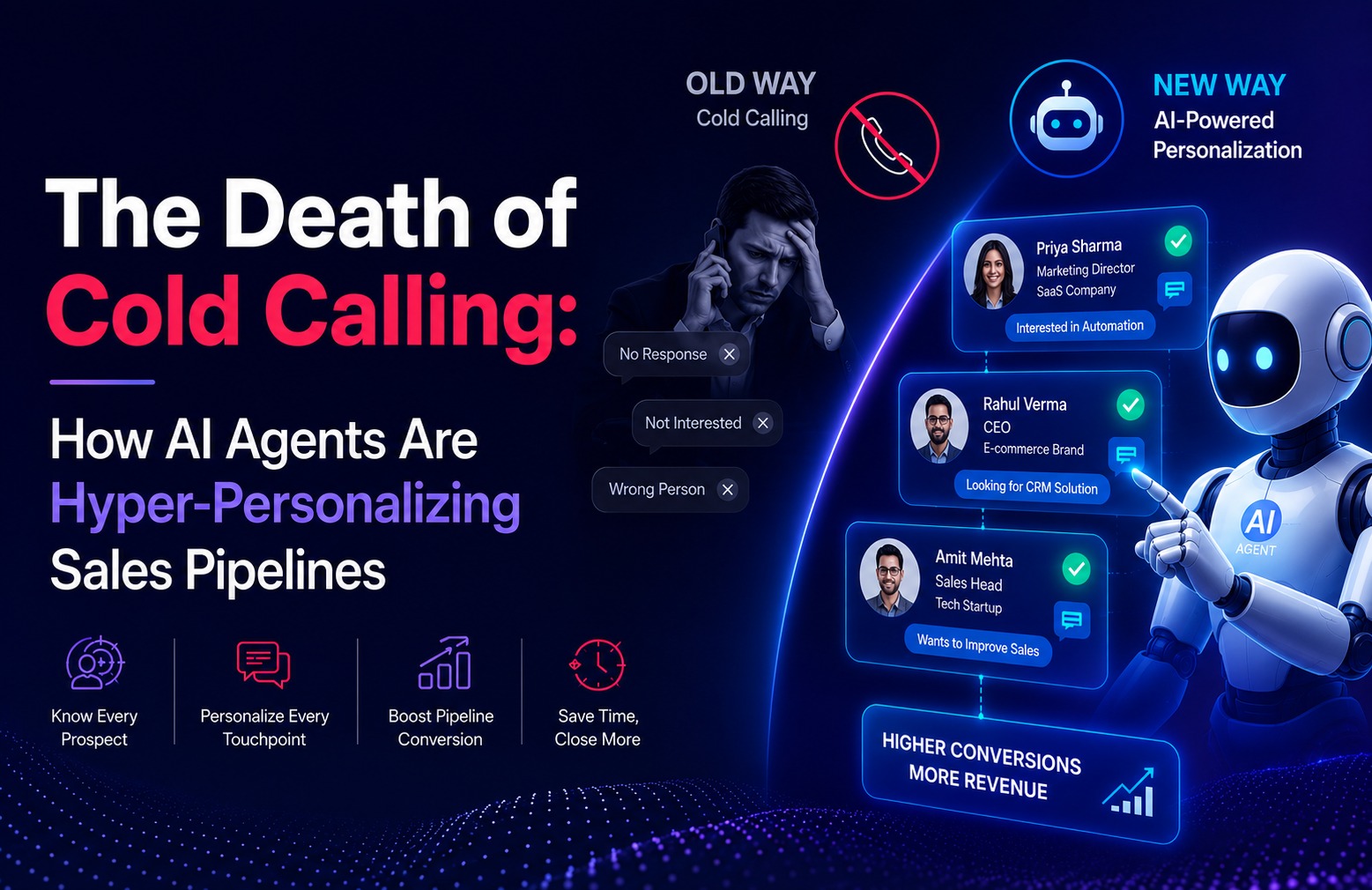
Cold calling is dying — and honestly, most sales teams aren't mourning it. If you're a sales leader, founder, or SDR trying to book more meetings without burning out your team on dead-end dials, this is for you. AI agents are changing how sales pipelines actually work — not in a sci-fi way, but in a "this is already happening at your competitor's company" kind of way.
The Decline of Traditional Cold Calling in Modern Sales
Why Conversion Rates Have Hit an All-Time Low
Cold calling success rates have nosedived to below 2% in most industries, meaning sales reps burn through hundreds of dials just to land one meaningful conversation. Buyers screen calls aggressively, voicemail boxes go unchecked, and generic scripts get tuned out instantly.
- Rep burnout skyrockets when teams make 50-100 cold calls daily with little to show for it
- Wasted hours on unqualified prospects drain budgets faster than most managers realize
- Brand reputation takes a hit every time a frustrated prospect gets an irrelevant pitch
- Cost per cold-call lead runs 60% higher than inbound, yet delivers far worse close rates
Buyer Expectations Have Permanently Shifted
Today's buyers do 70% of their research before ever talking to a sales rep. They expect vendors to already know their pain points, their industry, and their priorities before reaching out. A random cold call signals immediately that you haven't done your homework — and that first impression kills the deal before it starts.
Post-pandemic buying behavior, stricter spam regulations like GDPR and TCPA, and the explosion of digital self-service tools finally pushed sales teams past the breaking point. Pipeline targets stayed aggressive while cold outreach returns kept shrinking.
Understanding AI Agents and Their Role in Sales Pipelines
Not Just Automation — Reasoning in Real Time
Traditional automation tools follow rigid, rule-based scripts — if this happens, do that. AI agents are a completely different animal. They think, adapt, and make decisions on the fly based on context, patterns, and real-time data.
| Dimension | Automation Tools | AI Agents |
|---|---|---|
| Execution | Pre-defined workflows, no deviation | Reasons through new information dynamically |
| Conversations | Same sequence for everyone | Multi-step, handles objections, knows when to escalate |
| Personalization | Static templates | Message tailored to real behavioral signals |
| Data Sources | Single trigger event | Cross-references news, tech stack, hiring, sentiment |
How AI Agents Analyze Buyer Intent Signals in Real Time
Buyer intent isn't just about who visited your pricing page. AI agents pull together signals from dozens of sources simultaneously — job postings, LinkedIn activity, funding announcements, tech stack changes, content consumption, even social sentiment.
- A company hiring three new sales directors signals growth and potential budget
- Repeated visits to competitor comparison pages signal active evaluation mode
- Leadership changes often trigger new vendor conversations within 90 days
Key Technologies Powering Next-Generation Sales AI
Large Language Models
Power natural, context-aware communication and message personalization at scale.
Retrieval-Augmented Generation
Lets AI agents pull live, accurate company and prospect data instead of relying on stale training data.
Intent Data Platforms
Aggregate third-party behavioral signals across the web to flag buying readiness.
CRM Integrations
Feed historical deal data back into the agent's reasoning loop, making every interaction smarter than the last.
How AI Agents Deliver Hyper-Personalization at Scale
From Rich Prospect Profiles to Perfectly Timed Outreach
Building Detailed Prospect Profiles
AI agents pull together data from LinkedIn activity, company news, CRM history, website behavior, and social signals to build a rich picture of each prospect — across thousands of leads simultaneously, not one at a time.
Crafting Messages That Speak to Real Pain Points
Once the profile is built, AI agents generate outreach that feels like it was written by someone who genuinely did their homework — referencing a recent post, a market expansion, or a specific growth challenge.
Timing Outreach to Match the Buying Journey
AI agents track behavioral signals — like a pricing guide download or a repeat product page visit — and trigger outreach at the exact moment buying intent peaks, removing the guesswork that used to make timing feel like a coin flip.
Personalizing Across Every Channel
Email tone adjusts by industry and seniority, LinkedIn messages reference recent activity, SMS and chat meet prospects where they spend time, and ad retargeting syncs with CRM data — all running in parallel without a rep manually switching tools.
Real Business Wins From AI-Driven Sales Personalization
The Numbers Behind the Shift
| Metric | Traditional Cold Outreach | AI-Personalized Outreach |
|---|---|---|
| Response Rate | 1-2% | 15-30% |
| Lead Qualification Cycle | Weeks | Days |
| Rep Time on Prospecting | Full workweeks | 10-15 hours saved weekly |
| Revenue Growth (First 2 Quarters) | Flat / incremental | 20-40% increase |
When AI handles the heavy lifting of research, outreach, and initial qualification, sales reps stop wasting hours on manual prospecting. That time goes back into closing deals, building relationships, and having the kinds of conversations that actually need a human touch.
Businesses that jumped on AI sales personalization early are seeing real revenue impact — not marginal gains. Customer acquisition costs drop as conversion rates climb, and smaller teams punch way above their weight, competing with larger sales organizations.
AI Sales Agent Starter Kit
Everything you need to move your pipeline from cold dials to AI-personalized outreach — frameworks, templates, and platform checklists sent to your inbox.
AI Platform Evaluation Checklist
Compare tools against your CRM, team size, and personalization needs
CRM Integration Blueprint
Map triggers and scoring rules before you turn on automation
Metrics That Prove ROI
The five numbers to track instead of vanity open rates
Compliance Quick-Reference
GDPR, CCPA and TCPA basics for AI-driven outreach
Overcoming the Challenges of Adopting AI in Your Sales Process
Privacy, Trust, and Keeping the Human Touch
Addressing Data Privacy and Compliance
AI-driven sales tools collect and process enormous amounts of prospect data, so your team needs to stay sharp on GDPR, CCPA, and industry rules. Work with vendors offering transparent data usage policies, built-in consent management, and audit trails.
Getting Your Team to Trust AI Tools
Sales reps often push back on AI because they fear being replaced or micromanaged. The fix isn't a company-wide memo — it's showing them the wins early. Pilot with top performers first, let them share results with peers.
Avoiding Over-Automation That Strips Away the Human Touch
When every touchpoint feels robotic and templated, prospects notice — and they disengage fast. Keep humans in the loop for high-value account outreach, late-stage deal conversations, and any moment requiring empathy or nuanced negotiation.
Building Your AI-Powered Sales Pipeline Starting Today
Four Steps to a Successful Rollout
- 1 Choose the Right AI Agent Platform. Does it connect with your existing CRM, email, and LinkedIn? Can it personalize at the depth you need? Is it built for your team size? Platforms like Clay, Apollo, and Salesforce Einstein serve different pipeline maturity levels — match the tool to where your team actually is today.
- 2 Integrate Seamlessly Into Your Existing CRM Workflow. Your AI agent should live inside your CRM, not beside it. Map your current pipeline stages first, set clear triggers, and keep humans in the loop for high-value accounts — a clean CRM is non-negotiable here.
- 3 Measure the Metrics That Prove It's Working. Track reply rate (not just open rate), meetings booked per sequence, time-to-first-response, pipeline velocity, and conversion rate by segment. Run a simple A/B test against your old templated approach — the gap will tell you everything within 30 days.
- 4 Scale Your Personalization Engine as Pipeline Grows. Segment your ICP tightly, build modular message templates with dynamic variables, audit AI outputs monthly, and layer in feedback loops where rep responses train the system to get sharper over time.
The biggest mistake teams make is treating AI as a separate system running in parallel. What works for 100 leads a month breaks down at 10,000 — build with scale and clean data standards in mind from day one.
Start Small, But Start Now
Cold calling had a good run, but the numbers don't lie — buyers have tuned it out, and sales teams clinging to old-school outreach are leaving serious money on the table. AI agents have changed the game entirely, making it possible to reach the right people with the right message at exactly the right moment, without burning through your team's time and energy.
Yes, there are hurdles to adopting AI in your sales process — new tools, new habits, and some growing pains along the way. But those challenges are manageable, and the payoff is a smarter, faster pipeline that feels personal to every prospect you reach.
Start small if you need to, but start now. The teams building AI-powered pipelines today are the ones who'll be closing deals tomorrow while everyone else is still dialing cold numbers and hoping for the best.