
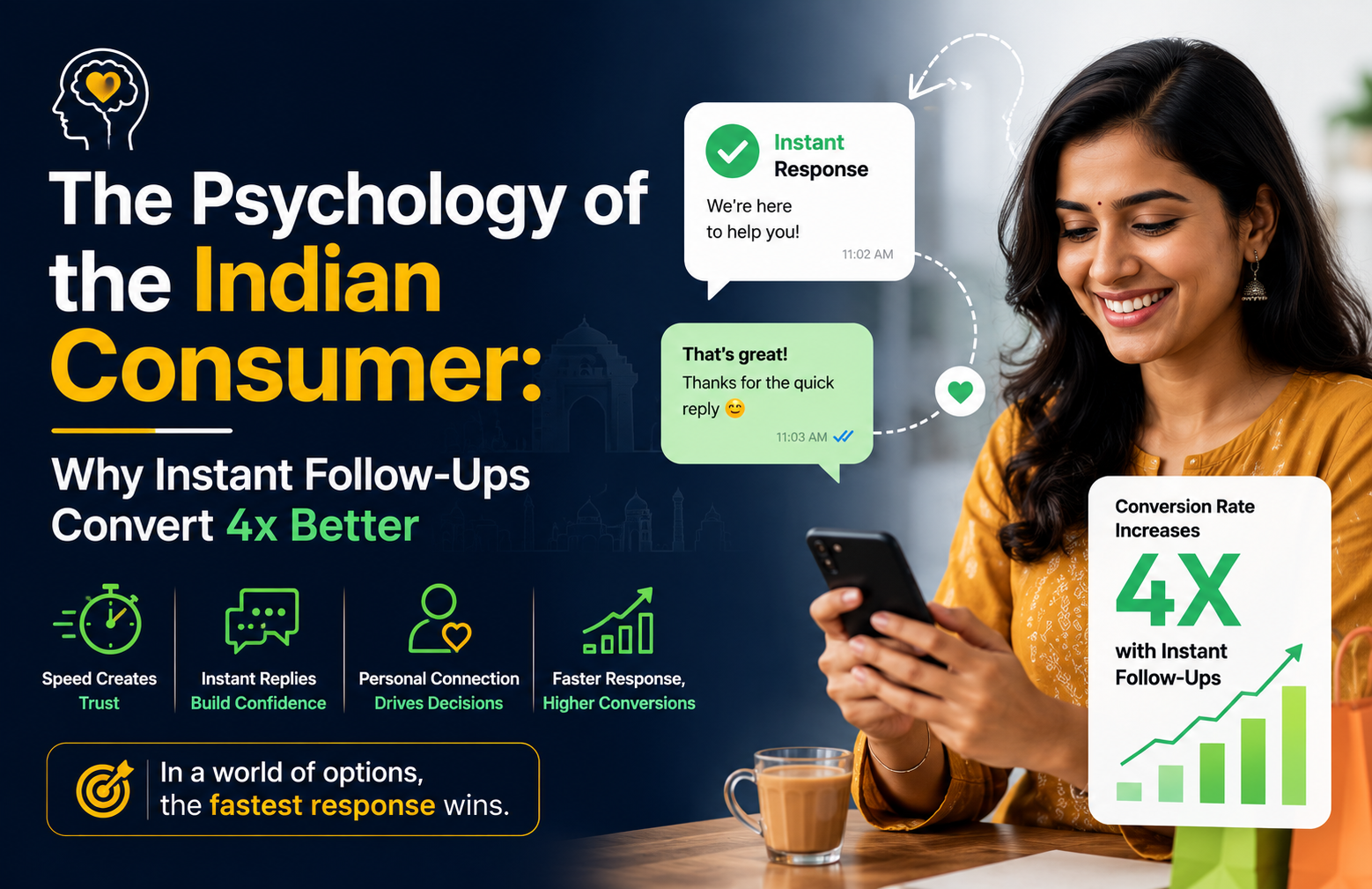
You reach out to a brand. You fill out a form. You wait. An hour passes. Then a day. By the time someone calls you back, you've already bought from someone else.
That's not just your experience. That's the reality for millions of Indian consumers every single day. And if you're running a sales team, managing leads, or trying to grow a business in India, this is the gap that's silently costing you deals. The Indian consumer moves fast, compares options instantly, and makes decisions while their interest is still hot. When your follow-up is slow, you're not just late—you're out of the running.
- Why the Indian consumer mindset is wired for speed and instant gratification
- The psychological principles that determine who wins (temporal discounting, primacy bias)
- Real data proving instant follow-ups convert 4x better than slow ones
- How delays silently destroy your entire sales pipeline
- The hidden bottlenecks slowing down your team's response time
- Proven strategies to achieve instant follow-ups at scale
- Why omnichannel communication is your biggest competitive weapon
Understanding the Active Decision-Making Window
The Moment Your Prospect Becomes Most Receptive
When your prospect submits an inquiry, they are in a peak decision-making state—highly motivated, emotionally engaged, and actively seeking a solution. This "active window" is incredibly short. Neuroscience research confirms that leads are most receptive to new information within the first few minutes of forming intent. The moment you delay, their cognitive focus shifts elsewhere, and their motivation drops sharply.
In India, where competition is fierce across real estate, fintech, education, and e-commerce, this window is even shorter. Your prospect has already opened three tabs comparing your competition. If you aren't there within minutes to catch them while the problem is top-of-mind, you lose the chance to frame the solution.
What This Means for Your Sales Pipeline
- High intent fades fast: Your prospect's urgency is strongest at the exact second they reach out. After 5 minutes, urgency begins to decline.
- Cognitive focus shifts: Even a 5-minute delay pulls their attention toward competing options or other distractions (notification on their phone, another browser tab, etc.)
- Lower motivation follows delay: The longer you wait, the harder you must work to re-engage them and rekindle their interest
Your prospect's peak receptivity window isn't measured in hours. It's measured in minutes. Miss it, and you've handed the deal to a competitor who was faster.
The Psychology Behind Instant Follow-Ups
Why Speed Builds Trust Before a Single Conversation Begins
There are three psychological principles at play when you respond instantly—and they all work in your favor:
Temporal Discounting
Your brain prioritizes immediate rewards over delayed ones. A response in 2 minutes feels valuable and professional. A response in 2 hours feels like an afterthought. The perceived value "discounts" as time increases.
Primacy Bias
Your first response isn't just a reply—it's your brand's first impression. The first piece of information carries the most weight in long-term memory. Being first to respond sets a benchmark competitors can't reach.
Reliability Signaling
When you respond instantly, your prospect assumes your entire operation is fast and efficient. Slow response signals disorganization before you've even spoken. First response = first judgment.
What Your Response Time Is Silently Communicating
- Fast response tells them: You are efficient, reliable, and value their time
- Slow response tells them: Poor service, disorganization, and indifference—before you've even spoken
The Data Behind 4x Conversion Growth From Instant Follow-Ups
The Numbers That Prove Speed Wins
The psychology is clear. But what about the hard data? Here's what research and real-world performance reveals about response time and conversion:
Responding Within 5 Minutes = 100x Higher Conversion
According to the Lead Response Management Study and Harvard Business Review research, responding within 5 minutes increases conversion rates by up to 100x and delivers 21x higher qualification rates compared to responses delayed by 30 minutes or more.
78% of Customers Buy From the First Company That Responds
Your speed of response directly determines your share of closed deals. Research confirms that 78% of customers purchase from the first company that responds to their inquiry. Every minute you wait hands your competitor a measurable advantage over you.
Calling Within One Minute = 391% Boost in Conversions
Now consider this: Calling within one minute of inquiry delivers a 391% boost in conversions, making speed your single most powerful sales weapon—more effective than pitch, discount, or feature.
The 20-Minute Attention Window
Studies show your leads retain new information and maintain high intent for only about 20 minutes before distractions take over. When you delay your follow-up, their attention drifts—straight toward your competitors.
How Response Delays Silently Destroy Your Sales Pipeline
The Hidden Damage You Can't See
Slow response times aren't just losing deals. They're systematically damaging your entire pipeline and your long-term customer relationships:
- 30% of leads are never contacted at all — Sales reps make an average of only 1.3 call attempts before giving up
- Each abandoned lead = direct revenue loss — Your business absorbs this cost silently every single day
- Delayed replies erode initial trust — Even when a deal eventually closes, your slow response has planted a seed of doubt
The Long-Term Cost: Churn and Low Retention
The damage doesn't stop after the initial sale. Slow follow-up during the sales process signals poor service quality to your customer, which:
- Erodes the trust built during the inquiry stage
- Increases churn rates as customers feel undervalued
- Drives retention risks, pushing customers toward competitors who respond faster
The Hidden Causes of Slow Follow-Ups in Indian Sales Teams
Why Your Best Intentions Still Miss the Mark
You want to respond fast. Your team wants to respond fast. But somewhere between the lead coming in and the phone ringing, time is slipping away. Here are the biggest culprits:
| Bottleneck | What Happens | Real Impact |
|---|---|---|
| Manual Lead Routing | Leads sit unassigned for hours or days during this transfer | Prospect interest completely fades |
| Disorganized Workflows | Follow-ups get delayed, buried, or completely forgotten | Leads slip through without any contact |
| Limited Rep Availability | Prospects reach out outside business hours or when reps are unavailable | First response becomes day-late response |
| No Lead Prioritization | Reps chase cold leads while hot ones go unanswered | Highest-intent leads lost to competitors |
| Siloed Communication | Different teams don't know lead is coming, duplicate outreach happens | Confused customer, wasted effort, poor experience |
Proven Strategies to Achieve Instant Follow-Ups and Win More Deals
How to Match the Speed of the Indian Consumer
The data is clear. The psychology is proven. Now here's how to actually implement instant follow-ups at scale:
Remove the "human bottleneck" in the administrative phase. Integrate your CRM (Salesforce, Zoho, HubSpot) with your lead sources (Facebook Ads, Google Forms, Website) to automate lead distribution instantly. This isn't just email—it's a phone notification to the right rep within seconds. You can assign leads based on:
- Geography: Route to the nearest available rep
- Availability: Ensure no lead sits unattended
- Expertise: Match prospects to the right specialist immediately
Not all leads are created equal. A user who visited your pricing page three times in ten minutes is far more "urgent" than someone who just downloaded an ebook. Lead scoring ranks prospects based on behavior and data. Your system automatically "fast-tracks" high-intent individuals to your top closers for immediate phone calls, while nurturing others through automated sequences.
Previously, reps wasted time on voicemails and dead-end calls. With AI-powered call handling, you gain:
- AI Speech Analytics: Identifies high-intent leads in real-time by analyzing tone and sentiment
- Answering Machine Detection (AMD): Filters out voicemails automatically
- Smart Callbacks: Reps connect only with real people, maximizing every conversation
Your fastest engagement tool: SMS. Since 90% of messages are read within three minutes, deploy pre-built templates for instant, consistent outreach. You can:
- Deploy automated SMS sequences triggered by lead behavior
- Keep conversations alive across every channel
- Reach leads immediately, regardless of where they originated
Meeting Indian Consumers Where They Are: The Omnichannel Approach
Why Single-Channel Strategy Loses Deals
Your Indian prospect doesn't live in one channel. They see your ad on Facebook, click to your website, and expect to continue the conversation on WhatsApp. If your response is only through email or phone, they're already talking to a competitor on their preferred platform.
The Channels That Matter for Indian Consumers
- 1 WhatsApp: High open rates and conversational familiarity make it your most powerful follow-up tool for India
- 2 SMS: Delivers instant, direct messages even without internet—reaching prospects where others can't
- 3 Live Chat Widgets: Provide real-time answers on your website, dramatically reducing competitor drop-off rates
- 4 Phone Calls: Still the highest-intent signal—especially when delivered within one minute
The Power of a Unified Omnichannel Platform
The true competitive advantage comes from a unified omnichannel approach. Your prospect might see an ad on Facebook, visit your site, and expect to continue on WhatsApp. If your data is siloed across platforms, you lose context. A unified platform ensures whether a lead comes via voice, SMS, or live chat, the sales rep sees the entire interaction history in one centralized interface. This prevents friction and creates seamless, high-speed conversion.
Brands that implement omnichannel follow-up (phone + SMS + WhatsApp + chat) report 2-3x higher conversion rates compared to single-channel approaches. For every minute saved through better channel selection, you win more competitive bids.
Instant Follow-Up Playbook
The complete system to ensure no lead ever goes cold. Includes lead routing templates, SMS sequences, channel selection guide, and the exact automation setup that top performers use to respond within 60 seconds.
Lead Routing Configuration
Automate lead distribution in seconds
SMS & WhatsApp Templates
Pre-built sequences for instant engagement
Lead Scoring Framework
Identify high-intent prospects instantly
Omnichannel Playbook
How to respond on customer's preferred channel
The Competitive Advantage Is Speed
The Indian consumer moves fast, and your sales strategy needs to keep up. The data is unambiguous: responding within minutes instead of hours boosts conversions by up to 100x. The first company to respond wins 78% of the time. And calling within one minute delivers a 391% conversion boost.
These aren't marginal improvements. These are game-changing returns. From the psychology of temporal discounting to the silent damage that delays cause in your pipeline, every section of this guide points to one truth: speed is not optional—it's your single biggest competitive lever.
When you combine that urgency with the right tools—AI-powered routing, lead scoring, SMS follow-ups, and omnichannel communication—you stop leaving deals on the table and start winning them systematically. The gap between where most Indian sales teams operate and where the best performers play is enormous. That gap is your opportunity. Make sure your business is the first company your prospect reaches.