
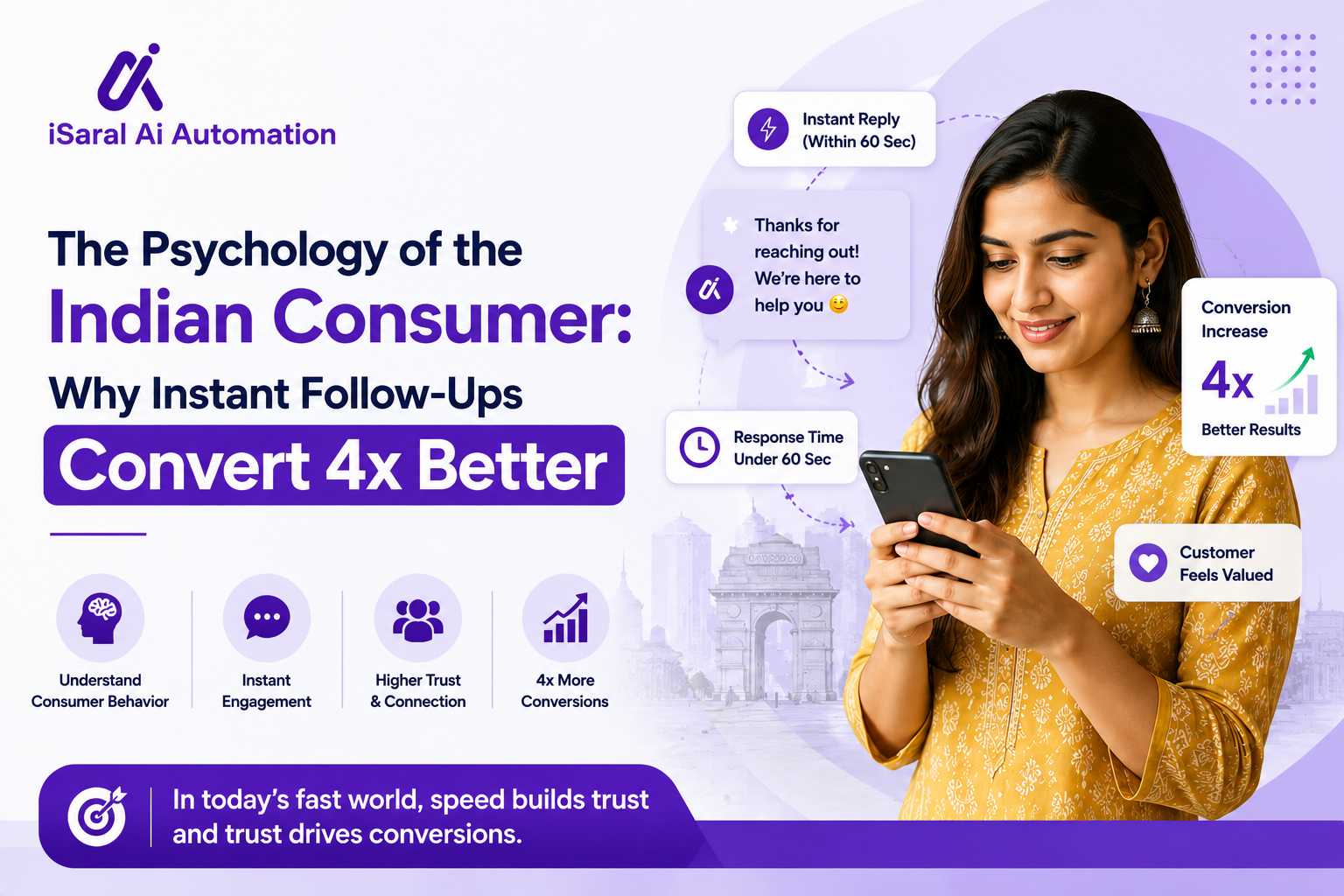
If you are selling to Indian consumers and wondering why your leads go cold so fast, your follow-up timing is likely the culprit. The Indian buyer thinks differently. They are emotionally driven, highly trust-sensitive, and make decisions fast—but only when the right person reaches out at the right moment. Miss that window, and they have already moved on to a competitor who was quicker.
If you are a sales manager, startup founder, or growth marketer in India, this guide breaks down the "why" and "how" of instant follow-up strategies that actually convert. We're covering the psychology, the data, and the actionable playbook to get it right.
- The unique mindset of Indian consumers and how culture shapes decisions
- Why relationships and trust matter more than product features
- The "Chai" effect: why the window of opportunity is impossibly short
- The neuroscience behind dopamine and instant acknowledgment
- Data proving the 4x conversion boost from instant follow-ups
- Why generic outreach fails the Indian market
- Proven strategies to implement instant follow-up systems
Understanding the Unique Mindset of the Indian Consumer
How Cultural Values Shape Buying Decisions
Your Indian customer isn't just buying a product; they are making a decision that involves family, community norms, and a deeply rooted sense of value for money. When you understand that collectivist thinking drives most purchase decisions here, you stop selling to individuals and start speaking to households.
This cultural context changes everything. An Indian buyer wants to feel that their purchase is:
- Validated by community: "Will my family approve of this purchase?"
- Fair value for money: "Am I getting the best deal available?"
- From a trustworthy source: "Can I rely on this brand when problems arise?"
These aren't just price considerations—they're emotional and social hurdles that your follow-up strategy must address.
The Trust Factor: Why Relationships Matter
Building Familiarity Through Rapid Response
Indian buyers have historically built relationships with local vendors over years. Your fast follow-up mimics the personal attention they grew up expecting from a trusted neighborhood shopkeeper. When you respond quickly, you are not just being "efficient"—you are signaling that your brand cares.
Quick response times are a language of care. In Indian culture, someone who makes time for you immediately signals respect and genuine interest in your success—not just the transaction.
Think of the vendor on your street who remembers your preferences, greets you by name, and prioritizes your needs. That's the relationship model your customers expect, and it starts with immediate acknowledgment of their inquiry.
Why Delays Feel Like Rejection
The psychology is simple: silence creates doubt. When a prospect fills out your form and hears nothing for hours, their brain completes the story: "Maybe I'm not important to them." That negative self-talk becomes a barrier to conversion, even if you follow up later with the perfect pitch.
The "Chai" Effect: Why the Window of Opportunity is Impossibly Short
How Interest Works Like a Hot Cup of Chai
Think of an Indian consumer's intent like a hot cup of chai. When they fill out a form or click an inquiry button, their interest is piping hot. If you leave it sitting too long, the warmth is gone, and the opportunity cools down. During that golden window—the first 5 minutes—your prospect is mentally rehearsing the purchase. If you don't step in, their attention drifts, and your competitor steps in.
The Golden Window
Interest is peak. Your prospect is actively thinking about buying. A response now feels personal and proves you care.
The Doubt Phase Begins
Silence is creeping in. "Maybe this brand isn't that responsive." Competitors are now top-of-mind again.
The Opportunity Closes
The chai is cold. Your prospect has moved on to researching alternatives or given up entirely.
This isn't speculation—it's backed by behavioral science and industry data.
The Science Behind Instant Follow-Ups
The Dopamine Rush of Immediate Acknowledgment
When a prospect clicks "submit," their brain releases a burst of dopamine tied to anticipation. An instant response feeds that neurological need, making them feel seen and valued. This isn't marketing fluff—it's neuroscience.
The expectation-reward cycle works like this:
- Prospect submits inquiry (dopamine anticipates a response)
- Instant response arrives (dopamine spike confirms their hope)
- Positive emotional association forms with your brand
- Higher likelihood of conversion and referral
Why Delays Trigger Doubt
Every minute you wait, silence fills the gap with doubt. The buyer starts thinking, "Maybe this isn't for me," or "Let me check what else is out there." In India, a slow response is often subconsciously labeled as "unreliable."
Research shows that with each passing hour, your conversion probability drops precipitously. The gap between instant response and a 1-hour delay is enormous—your competitor who responds faster wins the lead.
The Data Behind the 4x Conversion Boost
The Five-Minute Rule (Harvard Business Review Backed)
Research from the Harvard Business Review is clear: responding within 5 minutes increases your conversion rate by 100x compared to waiting 30 minutes. Let that sink in—not 10% better, but 100 times better.
For the Indian market specifically, the numbers are even more dramatic because cultural factors amplify the urgency effect.
Industry Benchmarks for India
| Segment | Avg Response Time | Conversion Impact vs Baseline |
|---|---|---|
| Global Average | 42 hours | Baseline (1x) |
| Slow Indian Brands | 2-4 hours | 1.5x baseline |
| Average Indian Brands | 30-60 minutes | 2x baseline |
| Top Indian Performers | Under 5 minutes | 4x baseline |
The pattern is undeniable: faster response = exponentially higher conversion. And for the Indian market, this effect is pronounced because expectation-setting and relationship-building happen in microseconds.
Why Traditional Methods Fail the Indian Consumer
The Cost of Generic Outreach
Generic "Dear Customer" templates ignore the regional nuances and personal nature of the Indian market. Robotic, mass-produced outreach tells the buyer you don't care enough to prioritize them. When someone takes the time to fill out your form, a generic response feels dismissive.
The Hidden Pipeline Bleed
Here's what happens when you don't follow up instantly:
- Hour 1: Interest drops by 40%
- Hour 3: Contact probability for competitors doubles
- Hour 12: Conversion probability falls below 10%
Your pipeline isn't broken—your follow-up timing is. Every hour you wait, you lose deals to competitors, not because your product is worse, but because you were slower to respond.
Proven Strategies to Implement Instant Follow-Up Systems
A. Automate Your Lead Routing
Use CRM tools like Zoho, Leadsquared, or HubSpot to fire instant responses the moment a lead comes in. Your automation should work 24/7, triggering SMS, email, and WhatsApp messages within 60 seconds.
Set Up Lead Capture Workflows
Every form submission triggers an immediate acknowledgment—before a human even sees the lead
Route High-Priority Leads Instantly
Critical leads go to your fastest reps' phones immediately, not an inbox they check every 15 minutes
B. Personalize for the Indian Context
Use the lead's first name, reference exactly what they browsed, and maintain a tone that feels like a friend. Acknowledge local festivals or regional preferences to build instant trust. This personalization—done instantly—is the difference between a converted lead and a lost one.
C. Build a Rapid-Response Team
Train your reps to view the first 5 minutes as the "golden window." They shouldn't be reading from a cold script; they should be offering genuine help. A question like "I saw you were interested in our premium plan—what's your biggest challenge?" beats any sales pitch.
D. Leverage WhatsApp and Regional Platforms
WhatsApp is the lifeblood of Indian communication. Use it for price breakdowns, video demos, and personal check-ins. For regional reach, platforms like ShareChat can help you connect in the buyer's native language.
Speed on the right channel matters more than perfection on the wrong one. A WhatsApp message in 2 minutes beats a perfectly written email in 2 hours.
Measuring and Optimizing Performance
Key Metrics to Track
Track your response time-to-conversion ratio closely. These are the numbers that matter:
- Time-to-first-response: How fast do you acknowledge each lead?
- Lead response rate: What percentage of your leads get a response in under 5 minutes?
- Conversion rate by speed bracket: How do conversions differ between 5-min vs 30-min response groups?
Scaling as You Grow
As your volume increases, manual follow-ups will break. Automate the first touchpoint, and let your team focus on the high-value conversations. Separate automated acknowledgment (instant) from personalized follow-up (within 5 minutes) from deeper selling conversations (whenever the lead is ready).
- Measure current response time across all channels
- Set a target of 5-minute response for all leads
- Automate 60-second acknowledgment
- Track conversion rates by response bracket
- Iterate and improve continuously
Instant Follow-Up Playbook
The complete system for implementing 5-minute response times across your sales team. Includes automation templates, response scripts, team workflows, and the exact metrics to track for 4x conversion improvement.
Lead Routing Automation Setup
60-second response template workflows
Personalized Response Scripts
Regional and culturally-aware templates
Team Training Playbook
How to build a rapid-response culture
Performance Tracking Dashboard
Metrics that drive conversion improvement
The First Response Wins
The Indian market rewards brands that feel personal and responsive. The data backs it up, and the gap between brands that follow up immediately and those that wait is massive—not just 10% or 20%, but 4x better conversions.
Stop losing leads to competitors who simply reply sooner. Your product isn't the problem; your follow-up speed is. Start auditing your response time today. Automate your first touchpoint to hit the 60-second mark. Train your team to own the first 5 minutes. Watch your conversion numbers climb.
The first company to respond wins. Make sure that company is yours. The psychology, the neuroscience, and the market data all point to the same conclusion: instant follow-ups are the hidden lever that converts leads into customers at scale in the Indian market.