
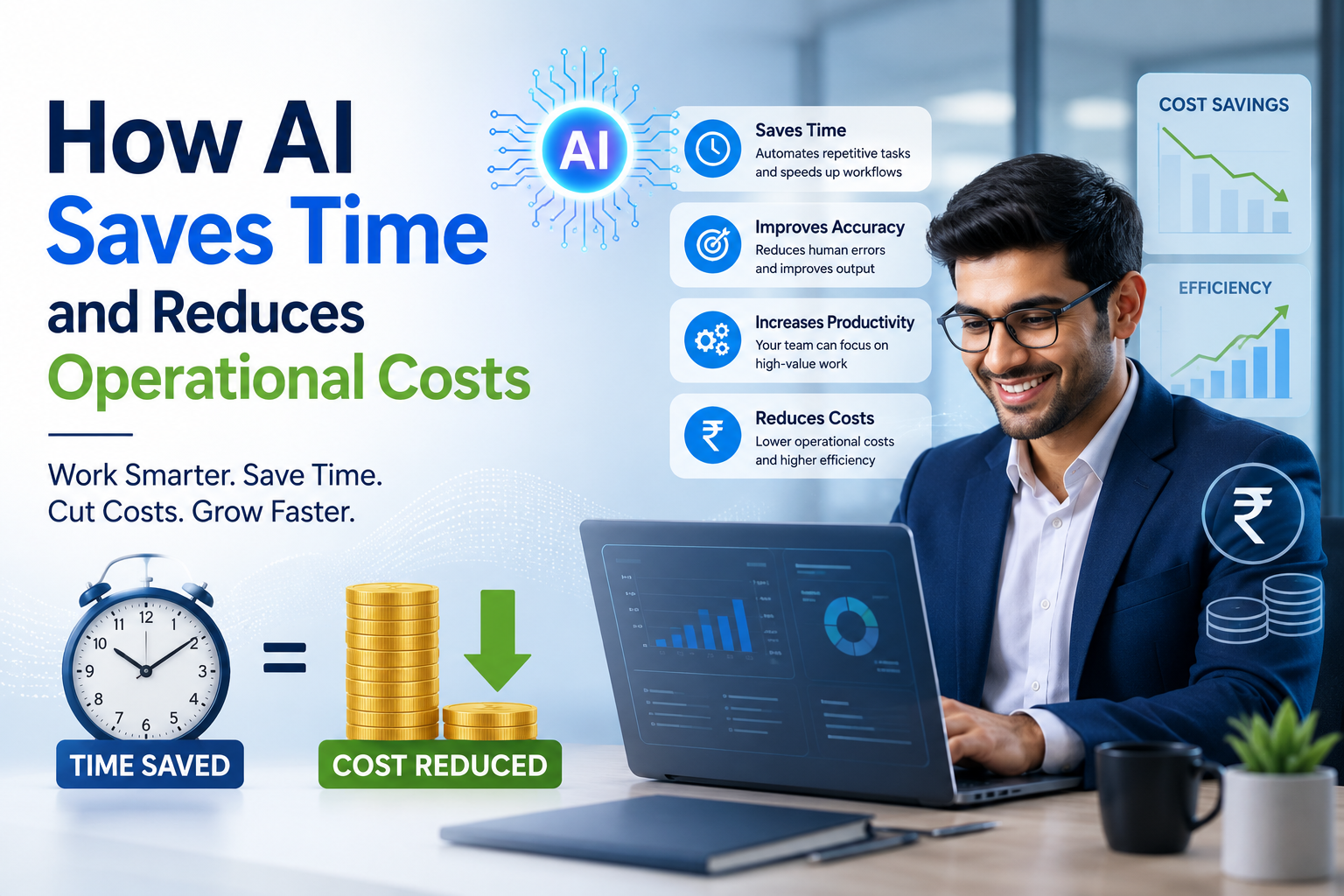
How AI Saves Time and Reduces Operational Costs
If you're running a business and feel like there's never enough time or money, you're not alone. Most business owners and operations managers are constantly looking for ways to do more without burning through their budget or burning out their team. That's exactly where AI comes in — and it's changing the game faster than most people expected.
This guide is for business owners , operations managers, and team leads who want real, practical answers about how AI cuts costs and saves time. We'll break down how AI drives efficiency across business operations, how it slashes labor costs through automation, and how smarter decision-making tools help your team stop wasting hours on tasks that don't move the needle. No fluff, no tech jargon — just a straight-up look at what AI can actually do for your bottom line.
Understanding How AI Drives Efficiency in Business Operations
Think about how many repetitive tasks happen in your business every single day. Emails get sorted. Data gets entered. Reports get pulled. Invoices get processed. Someone on your team is doing all of that manually — and it's eating up hours that could go toward work that actually grows the business.
AI handles those repetitive, time-consuming tasks automatically. It doesn't take breaks, doesn't make data entry errors, and doesn't need three follow-up reminders to get something done.
Effort That Compounds Across Teams
AI chatbots handle hundreds of queries at once, inventory systems predict shortages before they happen, and scheduling tools plan shifts in seconds — creating a ripple effect across the whole operation.
Cutting Labor Costs With AI-Powered Automation
Labor is typically the biggest line item in any business budget. Hiring, training, managing, and retaining staff costs a lot. And when most of your workforce is tied up in repetitive tasks, you're paying top dollar for work that a machine could handle in a fraction of the time. AI-powered automation directly attacks that problem.
Support & Service Automation
A single AI chatbot can handle thousands of conversations simultaneously — answering FAQs, processing returns, updating order statuses — without a human involved. That doesn't mean you fire your support team. It means your support team stops spending 80% of their day answering the same five questions and starts handling the complex issues that actually need a human touch.
- Instant answers to common questions, 24/7
- Automatic order status and return processing
- Human agents freed up for complex, high-value cases
Finance & Accounting Automation
The same logic applies to accounting and finance. AI tools can automatically match invoices, flag discrepancies, process payroll calculations, and generate expense reports. Tasks that used to take an accountant half a day now take minutes.
- Automatic invoice matching and discrepancy flagging
- Payroll calculations processed without manual entry
- Expense reports generated automatically from live data
Manufacturing & Logistics Savings
In manufacturing and logistics, AI-driven robotics and route optimization tools have cut operational labor costs significantly. Companies like Amazon have used AI to streamline warehouse operations so aggressively that they've reduced per-unit handling costs while increasing shipping speed.
- Robotics reducing manual handling in warehouses
- Route optimization cutting delivery time and fuel cost
- Lower per-unit handling cost at higher shipping speed
Saving Time Through Smarter Decision-Making
Bad decisions cost money. Slow decisions cost time. Both are killers in a competitive market. One of the most underrated ways AI saves businesses time is through faster, smarter decision-making. Traditional decision-making relies on gut instinct, experience, and whatever data someone managed to pull together before a meeting — a process that's slow, inconsistent, and often leaves money on the table.
AI-powered analytics tools change that completely. They pull from massive datasets in real time and surface insights your team would never catch manually. Instead of waiting two weeks for a sales report, you get a live dashboard showing exactly which products are trending, which regions are underperforming, and where your marketing budget is being wasted.
- ✓Dynamic Pricing — retail businesses adjust prices in real time based on demand, competitor pricing, and inventory levels.
- ✓Live Dashboards — see trending products and underperforming regions instantly instead of waiting on reports.
- ✓Faster Meetings — when the right information is available at the right moment, decisions that used to take days take hours.
Predictive Maintenance & Operations
For operations managers, AI tools can predict equipment failures before they happen, so maintenance teams fix things proactively instead of scrambling when something breaks mid-production. That's a huge time and cost saver.
- Equipment failure predicted before it causes downtime
- Maintenance scheduled proactively, not reactively
- Fewer emergency repairs and production stoppages
Reducing Operational Costs Across Key Business Functions
AI doesn't just impact one area of your business — it cuts costs across the board. Here's how it plays out function by function:
Marketing
AI analyzes customer behavior and automatically optimizes ad campaigns, cutting wasted spend and improving return on ad spend.
HR & Recruiting
AI-powered hiring platforms screen resumes, schedule interviews, and predict candidate success — shaving weeks off hiring and cutting cost per hire.
Supply Chain
AI forecasting helps order the right inventory at the right time, reducing overstock costs and avoiding lost revenue from stockouts.
Finance
Automated invoice matching, payroll, and expense reporting turn half-day tasks into minutes of work.
Customer Support
AI chatbots absorb repetitive queries so your human team can focus on the issues that actually need them.
Manual Processes vs AI-Powered Operations
Here's a side-by-side look at how manual, traditional processes compare to AI-powered operations across the areas that matter most:
| Function | Manual Process | AI-Powered Process |
|---|---|---|
| Customer Support | One query at a time, limited hours | Hundreds of queries at once, 24/7 |
| Invoice Processing | Manual matching, half a day per batch | Automatic matching in minutes |
| Inventory Planning | Reactive, based on gut instinct | Predictive, based on real demand data |
| Pricing Decisions | Static, reviewed periodically | Dynamic, adjusted in real time |
| Equipment Maintenance | Reactive repairs after failure | Predictive maintenance before failure |
| Hiring & Screening | Manual resume review, slow turnaround | Automated screening, faster time-to-hire |
| Security Monitoring | Business-hours human monitoring | Continuous 24/7 automated detection |
| Business Reporting | Manual reports, days or weeks stale | Live dashboards, always current |
Overcoming Challenges to Maximize AI Cost Savings
AI isn't a magic button you press and immediately start saving money. There are real challenges businesses face when adopting AI tools, and ignoring them is how companies waste their investment.
Many AI tools require clean, organized data to work properly. If your data is scattered across spreadsheets, old systems, or siloed departments, you'll need to do some groundwork before AI can deliver results.
Your team needs to understand how to use new AI tools effectively. Skipping training leads to underutilization — and an expensive tool that nobody uses isn't saving anyone anything.
Cost is a real concern, especially for smaller businesses. The good news is that AI tools have become dramatically more affordable, often available as monthly subscriptions rather than massive enterprise contracts. Automating one or two high-impact processes is a smart way to see results without overcommitting.
AI typically delivers cost savings gradually as it learns your data and your team adapts to new workflows. The businesses that see the biggest wins treat AI adoption as an ongoing process, not a one-time fix.
Getting Started With AI in Your Business
The payoff for getting it right is significant. Businesses that invest in AI strategically consistently report lower operational costs, faster workflows, and teams that are more productive and less burned out.
Pick One High-Impact Process
Choose the single most repetitive, time-consuming task in your business — customer support, invoicing, or scheduling — and automate that first.
Scale What Works
Once you see measurable time and cost savings in one area, expand AI adoption into the next department using the same playbook.
Find Out Where AI Can Save You the Most
Get a free, no-obligation assessment of the top processes in your business that AI can automate — with a clear ROI estimate.
Tailored to Your Business
We look at your actual workflows, not a generic checklist
No Cost, No Obligation
A genuine assessment with zero pressure to buy anything
Clear ROI Estimate
See the projected time and cost savings before you commit
Expert Guidance
Get a step-by-step roadmap for rolling out AI the right way
Final Thoughts
AI is no longer something only big corporations can afford or access. It's a practical tool that any business can use to cut costs, save time, and compete smarter.
The businesses that win with AI aren't the ones with the biggest budgets — they're the ones who start with a clear, high-impact process, train their team properly, and treat adoption as an ongoing process rather than a one-time fix.
The earlier you start, the bigger the head start you get.
Not Sure Where to Start With AI?
iSaral works with business owners and operations teams to identify the highest-impact processes to automate first, and guides the rollout from planning through training and adoption.