
 onerror="this.style.background='linear-gradient(135deg,#1a56db,#0e3fa3)';this.style.height='280px';this.style.display='block';" />
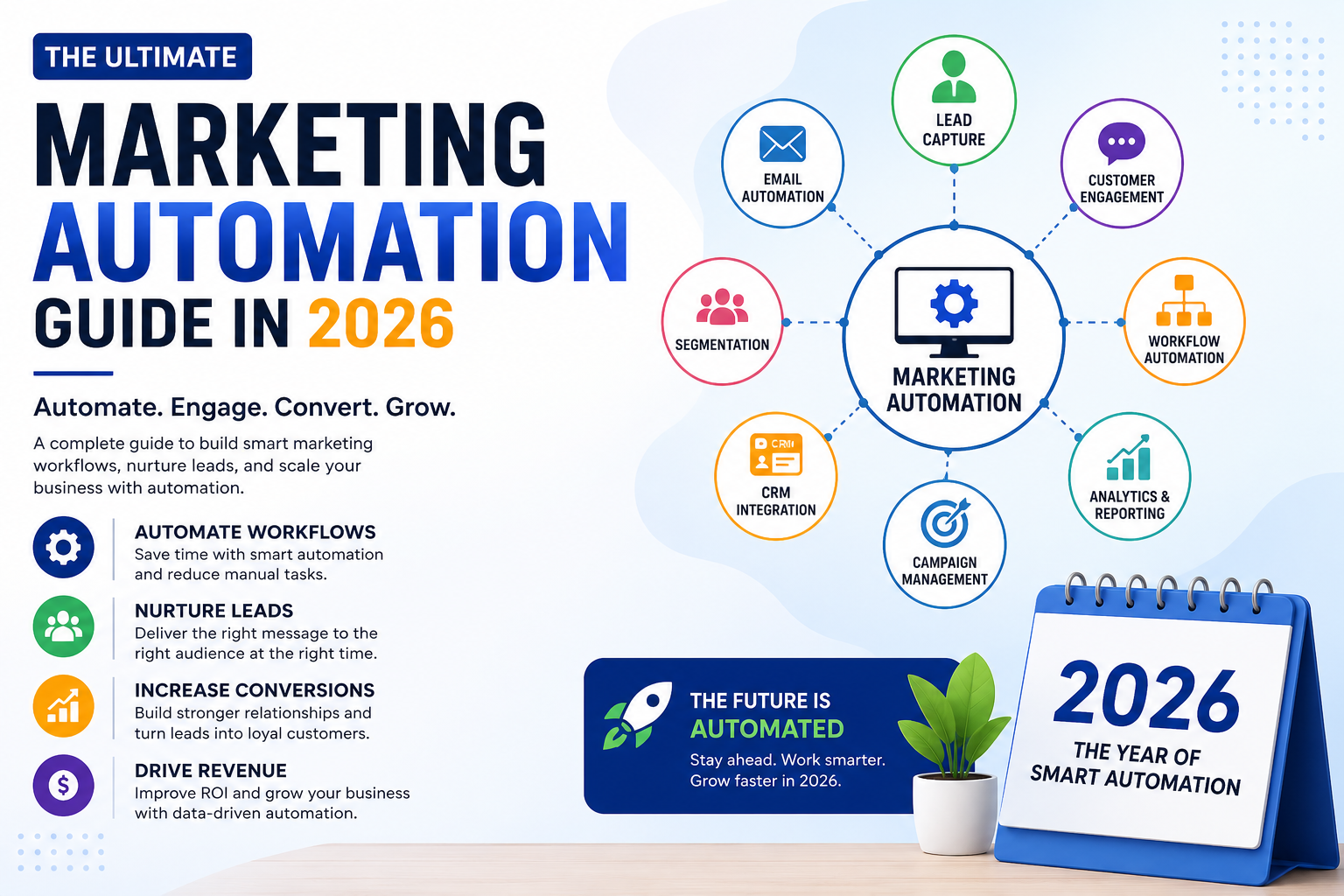
What Is Marketing Automation? A Complete Beginner's Guide (2026)
You're sending emails one by one, chasing leads manually, and somehow still missing follow-ups. There's a better way — and it doesn't require hiring a bigger team. Marketing automation lets you set up smart systems that handle repetitive tasks automatically, so you can focus on the work that actually moves the needle.
This guide is for small business owners, marketers, and sales teams who are tired of doing everything by hand and want to see real results without burning out. By the end, you'll know how to automate your campaigns, score leads, integrate with your CRM, and track performance — all while maintaining that personal touch that customers expect.
What Marketing Automation Actually Means in Simple Terms
Marketing automation is software that handles repetitive marketing tasks for you — automatically. Instead of manually sending every email, posting every social update, or following up with every lead one by one, you set up the rules once and the system does the work on autopilot.
Think of it like a very smart assistant who never sleeps. When someone signs up for your newsletter, your automation platform sends a welcome email. When a customer abandons their shopping cart, the system nudges them with a reminder. When a lead visits your pricing page three times in one week, the tool can flag them as hot and alert your sales team.
- Triggers — specific actions a user takes (clicking a link, filling out a form, making a purchase)
- Conditions — rules that define what happens next based on the trigger
- Actions — the actual output, like sending an email, updating a contact record, or launching an ad
Modern platforms go even further with smart AI automation, which analyzes behavior patterns, predicts what a customer is likely to do next, and personalizes messaging in real time.
How Marketing Automation Differs From Traditional Marketing
Traditional marketing is mostly a one-way broadcast. You craft a message, push it out to a broad audience, and hope it lands with the right people at the right time. Marketing automation flips that model entirely by responding to each individual based on their actual behavior.
| Factor | Traditional Marketing | Marketing Automation |
|---|---|---|
| Targeting | Broad audience segments | Individual-level personalization |
| Timing | Scheduled by the marketer | Triggered by user behavior |
| Scalability | More customers = more work | Scales without adding staff |
| Sales Alignment | Often disconnected | Feeds the sales pipeline directly |
| Speed of Follow-Up | Hours or days | Seconds |
| Personalization | Low to moderate | High, AI-driven |
Why Businesses of All Sizes Are Adopting It Fast
A few years ago, marketing automation was largely a tool for enterprise companies. That's changed completely. Today, a solo founder has access to the same automation capabilities as a Fortune 500 company — often for less than the cost of a daily coffee.
Too Many Touchpoints
Customers interact across email, social, SMS, chat, and search. Managing all manually is impossible at scale.
Personalization Demanded
People don't want generic messages. Personalized experiences drive higher engagement and more sales.
Teams Finally Work Together
Automated lead scoring means sales gets better leads faster, and marketing gets credit for pipeline influence.
Every Hour Counts
Time spent on repetitive tasks is time not spent on strategy, creativity, or relationships.
Email Automation and Drip Campaign Capabilities
Email automation is the backbone of almost every marketing automation platform. Instead of manually sending emails one by one, you set up sequences that go out automatically based on triggers.
Drip campaigns are email series spaced out over days or weeks, each nudging prospects further down the buying journey. A new subscriber might get a welcome email on day one, a helpful tips email on day three, and a soft pitch on day seven — none of this requires manual work after setup.
Triggered Emails
Sent automatically when someone takes a specific action.
Drip Sequences
Pre-written series delivered on a set schedule.
Behavioral Emails
Sent based on how someone interacts with your content.
A/B Testing
Test subject lines and content to find what works best.
Personalization Tokens
Dynamically insert names, company details, or recommendations.
AI Optimization
Predict best send times and auto-adjust sequences based on responses.
Lead Scoring and Segmentation Tools
Not every lead is sales-ready. Someone who visited your pricing page three times and downloaded your case study is much more ready to buy than someone who just opened one newsletter. Lead scoring helps your team tell the difference.
Lead scoring assigns points to contacts based on their behavior and profile. The more a lead interacts with your content, visits key pages, or matches your ideal customer profile, the higher their score. Once they hit a threshold, they're flagged for your sales team to follow up.
| User Action | Points Assigned |
|---|---|
| Opens an email | +2 |
| Clicks a link in email | +5 |
| Visits pricing page | +15 |
| Downloads a whitepaper | +10 |
| Requests a demo | +25 |
Beyond scoring, segmentation groups contacts by job title, industry, location, purchase history, or behavior. This means you send hyper-targeted messages instead of blasting everyone with the same content.
CRM Integration and Contact Management
A marketing automation platform without a CRM connection is like a car without an engine — technically there, but not going anywhere useful. CRM integration ties your marketing activity directly to your sales pipeline, giving both teams a complete picture of every contact.
- Sales reps don't see marketing activity
- Duplicate contacts in the system
- Manual data entry
- Inconsistent follow-ups
- Unified contact profiles
- Real-time data sync
- Automatic deduplication
- Seamless handoffs
Popular CRM integrations include Salesforce, HubSpot, Zoho, and Pipedrive. Many platforms also offer a built-in CRM, which removes the friction of syncing between tools entirely.
Analytics and Performance Tracking Dashboards
You can't improve what you don't measure. Analytics dashboards in marketing automation platforms give you a real-time view of what's working, what's not, and where contacts are dropping off in your funnel.
- ✓Email Performance — open rates, click-through rates, bounce rates, unsubscribes, revenue per email
- ✓Campaign Performance — leads generated, cost per lead, conversion rates, time to conversion
- ✓Sales Alignment — MQLs handed to sales, MQL-to-opportunity conversion, revenue influenced by marketing
- ✓Multi-Touch Attribution — see which touchpoints actually influenced a sale, not just the last click
Getting Started with Marketing Automation
Don't try to automate everything at once. Start small — maybe a welcome email sequence for new subscribers or a cart abandonment series for e-commerce.
Pick a tool that fits your business size, budget, and technical comfort. Popular options include HubSpot, Mailchimp, ActiveCampaign, Klaviyo, and Marketo.
Map out your workflow: when someone does X, send email Y. Keep it simple at first, then layer in complexity as you get comfortable.
A/B test subject lines, send times, and content. Monitor open rates, click rates, and conversions. Adjust based on what the data shows.
Common Challenges Businesses Face
While marketing automation is powerful, many businesses stumble during implementation. Here's how to avoid the common pitfalls:
| Challenge | What Goes Wrong | How to Fix It |
|---|---|---|
| Poor Data Quality | Sending to wrong contacts or duplicates | Clean your list before importing |
| Over-Automation | Too many emails drive people away | Be strategic, not spammy |
| Weak CRM Setup | Marketing and sales can't see the same data | Plan integration before launch |
| Ignoring Analytics | No optimization happens | Review metrics weekly |
| Lack of Personalization | Automation feels robotic and impersonal | Use dynamic content and tokens |
Best Practices for Successful Automation Implementation
- Clearly define your goals before building workflows
- Start small and build incrementally
- Integrate CRM and marketing tools early
- Test every email sequence before going live
- Monitor performance metrics regularly
- Segment your audience and personalize messaging
- Review and optimize at least monthly
- Train your team on how the system works
Businesses that adopt these habits see significant improvements in lead quality, conversion rates, and customer satisfaction.
FAQs
1. What is marketing automation?
Marketing automation is software that automatically handles repetitive marketing tasks like emails, lead scoring, and contact management based on predefined triggers and rules.
2. How does marketing automation help with lead generation?
It captures leads, scores them based on behavior, segments them, and nurtures them with targeted content — automatically putting sales-ready leads in front of your team.
3. Can small businesses use marketing automation?
Absolutely. Modern platforms are affordable and easy to use, making them perfect for small teams that want to scale their marketing without hiring additional staff.
4. How long does it take to see results from marketing automation?
Most businesses see improvements in lead quality and conversion rates within the first month. More significant ROI typically shows up within 3-6 months.
5. What's the difference between marketing automation and CRM?
Marketing automation handles campaigns and lead nurturing. CRM manages customer relationships and sales pipelines. Together, they create a complete system for growth.
6. Is marketing automation worth the cost?
Yes. The time saved on repetitive tasks, improved lead quality, and higher conversion rates typically pay for themselves many times over within the first year.
Final Thoughts
Marketing automation is one of those things that sounds complicated at first but makes total sense once you see it in action. At its core, it's about working smarter — letting technology handle the repetitive stuff so you can focus on building real connections with your audience.
From email sequences and lead nurturing to CRM integrations and campaign tracking, the right platform can genuinely transform how your business grows.
You don't need a massive team or huge budget to get started. Start small, pick one process to automate, and build from there. The sooner you get started, the sooner you'll wonder how you ever managed without it.
Get a Free Marketing Automation Strategy Call
Share your marketing goals and our team will walk you through email automation, lead scoring, and CRM integration — free of charge.
Email Automation & Drip Campaigns
Set up sequences that nurture leads automatically
Lead Scoring & Segmentation
Identify ready-to-buy leads automatically
CRM Integration Setup
Sync marketing and sales data seamlessly
Analytics & Performance Tracking
See what's working and optimize continuously