
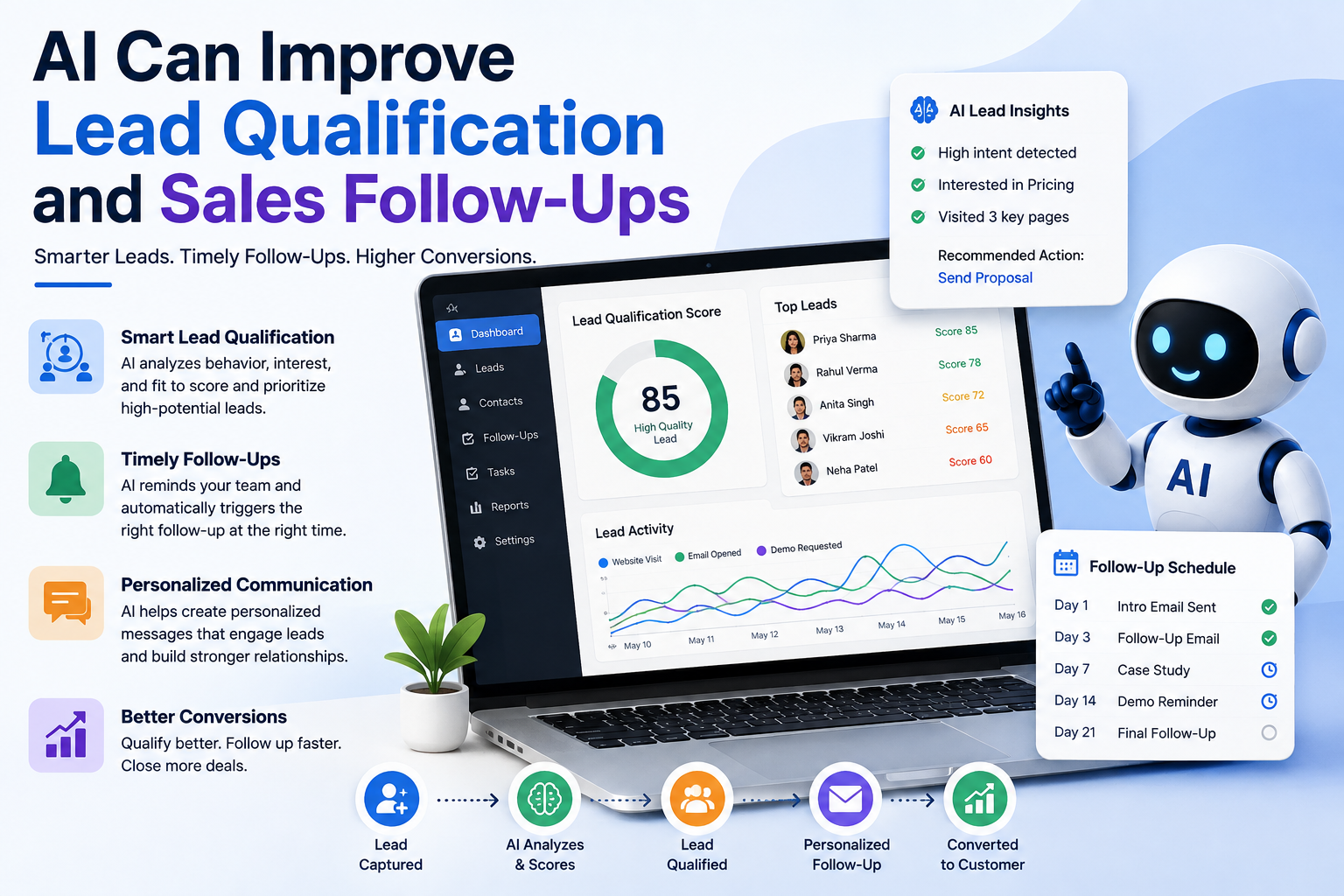
How AI Can Improve Lead Qualification and Sales Follow-Ups
Generating leads is only the first step in the sales process. The real challenge is identifying which leads are most likely to become customers and following up with them at the right time.
Traditional lead management often depends on spreadsheets, manual data entry, and sales representatives remembering when to contact prospects. As the number of leads grows, this approach can result in missed follow-ups, slow responses, and valuable opportunities being lost.
AI-powered CRM solutions can help businesses automate lead qualification, prioritize prospects, personalize follow-ups, and give sales teams better visibility into their sales pipeline.
What Is AI-Powered Lead Qualification?
Lead qualification is the process of determining whether a prospect is likely to become a customer.
- Lead source
- Customer requirements
- Previous interactions
- Website activity
- Responses to forms
- Email engagement
- Purchase intent
- Industry and company information
- Previous conversations
Why Lead Qualification Matters
Not every lead has the same level of interest. For example, one person may only be researching a product, while another may be ready to request a quotation. If sales representatives spend the same amount of time on both prospects, valuable time may be wasted.
- Identifies high-potential prospects
- Reduces time spent on unqualified leads
- Prioritizes sales activities
- Improves response times
- Increases sales productivity
- Creates a more organized sales pipeline
- Improves conversion opportunities
- Speeds up decision-making
AI makes this process faster by analyzing large amounts of customer and interaction data automatically.
How AI Improves Lead Qualification
AI can assign scores to leads based on different customer signals. For example, a lead that has repeatedly visited your website, downloaded a product guide, requested pricing information, and interacted with your sales team may receive a higher score than a lead that has only submitted a basic enquiry.
Sales teams can use these scores to decide which prospects should receive immediate attention.
AI can identify patterns that indicate purchase intent, such as:
- Requesting a product demo
- Asking about pricing
- Submitting a detailed enquiry
- Visiting product pages repeatedly
- Responding to sales messages
- Downloading product information
- Scheduling a meeting
When several high-intent signals appear together, AI can alert the sales team or automatically move the lead to the next stage of the sales process.
Without automation, sales teams may need to manually review every enquiry and decide which leads should be contacted first. AI can help organize incoming leads based on predefined rules, customer information, engagement, and buying signals — allowing sales representatives to spend more time having meaningful conversations instead of sorting data.
AI-powered CRM systems can organize leads according to their potential value and sales readiness.
- Strong purchase intent
- Requesting immediate information
- Interested but needs more information
- Not ready to decide yet
- Limited engagement so far
- Still in the research stage
How AI Improves Sales Follow-Ups
Qualifying a lead is only part of the process. The next challenge is making sure every important lead receives timely follow-up. AI-powered CRM automation can help businesses create a consistent follow-up process.
When a new enquiry arrives, an AI-powered CRM can trigger an immediate response or notify the appropriate sales representative. Fast responses are important because prospects may contact multiple businesses while researching a product or service, and responding quickly helps businesses stay engaged while interest is high.
Sales representatives may manage dozens or hundreds of leads at the same time. AI-powered CRM automation can create reminders based on lead status, previous communication, follow-up schedules, customer activity, and sales pipeline stage — reducing the possibility of leads being forgotten.
Generic messages may not always generate strong engagement. AI can use available customer information to help create more relevant follow-up messages that reference the customer's previous enquiry, product interest, or specific requirement — making sales communication more relevant and useful.
Timing can have a major impact on sales conversations. AI can analyze previous interactions and customer activity to help sales teams determine when another follow-up may be appropriate — for example, if a prospect opens an email or returns to a product page, the CRM can notify the sales representative that the prospect is active again.
Some prospects may require several interactions before they are ready to purchase. A CRM can support a sequence such as:
- Day 1: Initial response
- Day 3: Product information
- Day 7: Follow-up message
- Day 14: Special offer or consultation
- Day 21: Final follow-up
AI can help manage these workflows while allowing sales teams to step in whenever human interaction is required.
AI + CRM: A Better Lead Management Process
When AI is integrated with CRM software, businesses can create a more organized lead management workflow. The CRM stores customer information while AI helps analyze the available data and automate repetitive tasks, creating better visibility across the entire sales pipeline.
Example of AI Lead Qualification
Consider a business that receives 100 enquiries every month. With a manual process, the sales team may need to review all 100 leads individually. With AI-powered lead qualification, the system can analyze the available information and identify leads with stronger buying signals.
| Lead Segment | Count | Recommended Action |
|---|---|---|
| High Purchase Intent | 20 leads | Immediate sales attention |
| Requires Nurturing | 35 leads | Automated nurture workflow |
| Low or Unclear Intent | 45 leads | Continue monitoring engagement |
The sales team can focus its immediate attention on the 20 high-priority leads while automated workflows continue nurturing the remaining prospects — helping sales representatives use their time more efficiently.
Benefits of AI-Powered Lead Qualification and Follow-Ups
Better Sales Productivity
Automation reduces repetitive administrative tasks and allows reps to focus on conversations.
Fewer Missed Opportunities
Automated reminders and workflows reduce the risk of forgetting important follow-ups.
Faster Response Times
New leads can be routed, prioritized, and responded to more quickly.
Improved Customer Experience
Relevant and timely communication creates a smoother experience for prospects.
Better Pipeline Visibility
CRM dashboards help managers understand which leads are new, qualified, or ready to convert.
Consistent Follow-Ups
Automated workflows maintain a consistent communication process across all leads.
How Small Businesses Can Use AI for Sales
AI is not only useful for large enterprises. Small businesses can also use AI-powered CRM automation to manage sales activities more efficiently — capturing website enquiries, organizing customer information, scoring incoming leads, assigning leads to reps, sending automated responses, scheduling follow-up reminders, tracking interactions, monitoring pipeline progress, and identifying leads that need immediate attention.
This can help small sales teams manage more opportunities without significantly increasing administrative workload.
Best Practices for AI-Based Lead Management
- ✓Define Your Ideal Customer: Identify the characteristics of your ideal customer before scoring leads
- ✓Set Clear Qualification Criteria: Decide which factors indicate a qualified lead — budget, requirement, company size, location, or intent
- ✓Keep Customer Data Updated: AI recommendations are only as useful as the data available to the CRM
- ✓Create Follow-Up Workflows: Define when and how leads should be contacted after an enquiry
- ✓Combine AI With Human Interaction: High-value prospects often require personalized discussions and relationship building
- ✓Monitor Results: Track response time, qualified leads, conversion rate, and follow-up performance regularly
Key Metrics & The Future of AI in Sales
Businesses can measure the effectiveness of AI-powered lead management using metrics such as:
Track Speed & Quality
Lead qualification rate, lead response time, follow-up completion rate, and number of qualified opportunities.
Track Cost & Return
Sales conversion rate, cost per lead, customer acquisition cost, sales cycle length, and revenue generated from leads.
AI is becoming an important part of modern CRM systems. Businesses are increasingly using AI to analyze customer data, automate repetitive activities, improve sales forecasting, and deliver more personalized customer experiences.
Make Your Sales Process Smarter
Get expert guidance to set up lead scoring, automate follow-ups, and build a scalable sales pipeline.
Lead Scoring Audit
Evaluate your current lead sources and qualification criteria
Follow-Up Workflow Design
Custom multi-step follow-up sequences for your sales process
Implementation Support
End-to-end setup, configuration, and testing
Team Training
Comprehensive training for your sales team
Conclusion
AI can significantly improve the way businesses qualify leads and manage sales follow-ups. By analyzing customer signals, scoring prospects, automating reminders, personalizing communication, and prioritizing sales opportunities, AI-powered CRM systems can help sales teams work more efficiently.
For growing businesses, combining AI, CRM, lead management, and sales automation can create a more organized and scalable sales process. Instead of manually managing every lead, businesses can use AI to identify the opportunities that deserve attention and ensure that potential customers receive timely follow-ups.
If you're ready to make your sales process smarter, iSaral AI can help you implement an AI-powered CRM tailored to your business needs.
Why Choose iSaral AI CRM?
At iSaral.ai, we offer an AI-powered CRM solution designed to help businesses qualify leads faster and never miss a follow-up.
Focus on What Converts
Automatically score and prioritize leads so your team spends time on the prospects most likely to buy.
Never Miss an Opportunity
Multi-step, personalized follow-up workflows that run automatically and integrate with WhatsApp, email, and other tools.
Frequently Asked Questions
Does AI replace sales representatives?
No. AI should support sales representatives rather than completely replace human conversations. High-value prospects often require personalized discussions and relationship building that AI cannot fully replicate.
How does AI decide which leads are high priority?
AI analyzes signals such as website activity, form responses, email engagement, and purchase intent to assign a score, then groups leads into high, medium, or low priority based on that score.
Is AI lead qualification useful for small businesses?
Yes. Small businesses can use AI-powered CRM automation to capture, score, and follow up on leads without significantly increasing administrative workload.
What happens if a lead goes unqualified initially?
Leads with low or unclear intent are typically placed into automated nurture workflows and continue to be monitored for new buying signals over time.
Which metrics should I track to measure success?
Common metrics include lead qualification rate, response time, follow-up completion rate, sales conversion rate, cost per lead, and sales cycle length.
Can AI personalize follow-up messages automatically?
Yes. AI can use available customer information — such as previous enquiries or product interest — to help generate more relevant, personalized follow-up messages instead of generic ones.
Explore More Resources
Why 80% of Small Businesses Waste Time on WhatsApp
Discover how to streamline your communication and boost productivity with AI-powered CRM integration.
🧠 Consumer InsightsThe Psychology of Indian Consumers
Discover the key factors that influence Indian consumer behavior, purchasing decisions, and buying patterns to help businesses create effective marketing and sales strategies.
🎯 Lead GenHow AI CRM Helps Close More Sales
Strategic guide to attracting, qualifying, and converting high-value prospects with AI-powered CRM automation.