
How AI Improves Employee Productivity: A Complete Guide for Modern Businesses (2026)
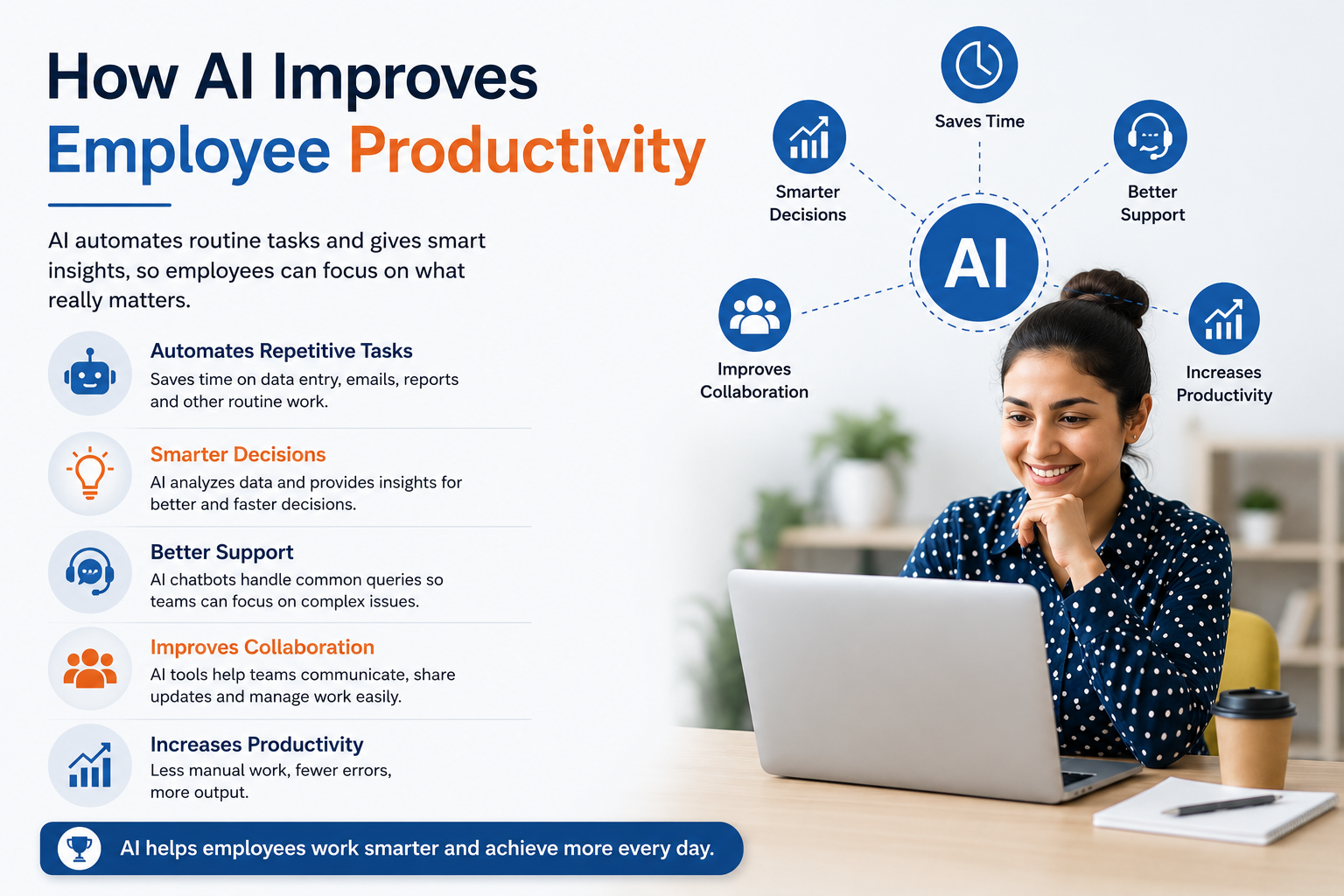
Artificial Intelligence (AI) is no longer a futuristic concept—it has become a practical tool that is transforming workplaces across industries. From automating repetitive tasks to providing real-time insights, AI empowers employees to work smarter, make informed decisions, and focus on high-value activities instead of routine work.
As businesses face increasing competition and rising customer expectations, improving employee productivity has become a top priority. Organizations are turning to AI-powered solutions to streamline workflows, reduce manual effort, and create a more efficient work environment.
In this comprehensive guide, we'll explore how AI improves employee productivity, its benefits, real-world applications, and best practices for successful AI adoption.
What Is AI in the Workplace?
Artificial Intelligence in the workplace refers to software and systems that mimic human intelligence to perform tasks such as analyzing data, recognizing patterns, understanding language, predicting outcomes, and automating processes.
Instead of replacing employees, AI acts as a digital assistant that supports teams by reducing repetitive work and providing valuable recommendations. This enables employees to spend more time on creative thinking, innovation, customer relationships, and strategic decision-making.
- AI chatbots for customer support and internal assistance
- Automated email responses and prioritization
- Smart scheduling and meeting assistants
- Predictive analytics for business insights
- AI-powered CRM systems for customer relationship management
- Intelligent document processing and data extraction
- Workflow automation platforms for process improvement
Why Employee Productivity Matters
Employee productivity directly impacts a company's profitability, customer satisfaction, and overall business growth. Higher productivity leads to:
- Faster project completion
- Improved customer service quality
- Reduced operational costs
- Higher revenue generation
- Faster time-to-market
- Better work-life balance
- Improved job satisfaction
- Reduced stress levels
- Enhanced career growth
- Greater engagement
10 Ways AI Improves Employee Productivity
Below are the primary ways AI enhances productivity across modern workplaces:
Employees often spend hours performing repetitive activities that consume time without adding significant value:
- Data entry and information management
- Invoice processing and approvals
- Email sorting and filing
- Report generation and compilation
- Appointment scheduling and calendar management
- Spreadsheet updates and data reconciliation
- CRM data management and record updates
Manual processes are prone to costly mistakes that impact business operations:
- Incorrect calculations in financial reports
- Duplicate customer records causing confusion
- Missing critical customer information
- Typographical errors in communications
- Wrong invoice details creating disputes
AI performs tasks with high accuracy and consistency, significantly reducing costly mistakes and improving overall quality.
AI analyzes large volumes of business data within seconds, providing actionable insights instead of requiring hours of manual analysis.
Managers receive:
- Real-time sales trends and forecasts
- Customer behaviour patterns and preferences
- Revenue forecasts and financial projections
- Inventory insights and supply chain optimization
- Employee performance metrics and analytics
Customer support teams often receive hundreds of repetitive questions daily. AI chatbots instantly answer common inquiries:
- Order status and tracking information
- Business hours and location details
- Pricing and product availability
- Appointment booking and scheduling
- Product availability and inventory status
This allows customer service representatives to focus on complex issues that require human expertise and empathy.
Frequent interruptions severely reduce productivity. AI minimizes distractions by intelligently managing workflow:
- Prioritizing emails by importance and urgency
- Automatically scheduling meetings at optimal times
- Organizing and prioritizing daily tasks
- Sending smart reminders for important deadlines
- Intelligently managing notifications to reduce interruptions
Employees can stay focused on their most important work without constant context switching.
Finding information across emails, documents, and databases can consume valuable time. AI-powered search tools quickly locate:
- Company policies and procedures
- Project documents and files
- Customer records and history
- Training materials and resources
- Previous reports and analyses
Employees spend less time searching and more time working on important tasks.
AI improves teamwork across distributed and co-located teams by:
- Automatically summarizing meetings for those who couldn't attend
- Transcribing conversations and generating action items
- Intelligently assigning tasks based on skills and capacity
- Tracking project progress and identifying bottlenecks
- Recommending next actions and dependencies
Remote and hybrid teams especially benefit from AI-powered collaboration tools that keep everyone aligned.
Marketing and sales teams create large amounts of content every week. AI assists with:
- Generating email drafts and subject lines
- Creating blog article outlines
- Writing social media captions
- Developing product descriptions
- Creating presentation outlines
- Generating proposal templates
Employees can produce quality content much faster while maintaining consistency and brand voice.
Every employee has different learning needs. AI creates customized training programs based on:
- Individual skill gaps identified through assessments
- Preferred learning pace and style
- Job role requirements and responsibilities
- Career goals and development aspirations
- Performance metrics and improvement areas
Continuous, personalized learning helps employees stay productive and adapt to changing technologies.
AI scheduling assistants help employees work more efficiently by:
- Automatically scheduling meetings based on availability
- Managing calendars to prevent double-booking
- Setting intelligent reminders for important tasks
- Automatically optimizing daily schedules
- Reducing time spent on scheduling communication
Employees spend less time organizing their day and more time completing meaningful work.
Industries Benefiting from AI Productivity
Manufacturing
AI improves production planning, quality control, predictive maintenance, and inventory management for higher efficiency.
Healthcare
Healthcare professionals use AI for patient scheduling, medical documentation, diagnosis support, and administrative automation.
Finance
Banks use AI for fraud detection, risk assessment, loan approvals, and automated reporting for faster decisions.
Retail
Retailers benefit from demand forecasting, inventory optimization, customer recommendations, and automated billing.
Human Resources
HR teams use AI to screen resumes, schedule interviews, answer employee questions, and manage onboarding processes.
Customer Service
Support teams deploy AI chatbots for instant responses while complex issues get escalated to experienced agents.
Real-World Examples of AI Productivity
Before AI:
- Manual lead tracking in spreadsheets
- Tedious spreadsheet management
- Time-consuming manual follow-ups
After AI:
- Automated lead scoring identifies hot prospects
- Smart reminders ensure timely follow-ups
- Personalized email sequences are generated automatically
Before AI: Teams manually create blogs, social posts, and marketing materials from scratch.
After AI: AI generates first drafts, keyword suggestions, content ideas, and performance predictions.
Before AI: Customer service agents handle every inquiry regardless of complexity.
After AI: Chatbots answer routine questions while agents resolve complex issues.
Benefits of AI for Employees
Employees directly experience multiple advantages when AI is implemented effectively:
- ✓Less Repetitive Work — Frees up time for more engaging activities
- ✓Improved Work-Life Balance — Reduced overtime and burnout
- ✓Reduced Stress — Fewer manual tasks and administrative burden
- ✓Faster Task Completion — Efficiency gains throughout the day
- ✓Better Collaboration — Improved team communication and coordination
- ✓More Creative Opportunities — Time for innovation and problem-solving
- ✓Career Development — Opportunities to learn new skills and advance
Benefits of AI for Businesses
Organizations implementing AI experience significant competitive advantages:
Increased Productivity
Measurable improvements in output, efficiency, and task completion rates across departments.
Reduced Costs
Lower operational expenses through automation and improved resource utilization.
Better Experiences
Faster response times, personalized interactions, and improved service quality.
Faster Decisions
Data-driven insights enable quicker, more informed strategic decisions.
- 1Higher Employee Engagement — Teams focus on meaningful work
- 2Improved Profitability — Cost savings and revenue growth
- 3Competitive Advantage — Outpace competitors with efficiency
Best Practices for Implementing AI
Begin with one specific business process before expanding AI across the organization. Good starting points include:
- Customer support automation with chatbots
- Invoice processing and approvals
- Email management and prioritization
- Meeting scheduling and calendar management
Provide proper training so employees understand how AI tools work and can use them effectively:
- Hands-on training sessions with AI tools
- Clear documentation and user guides
- Best practices for using AI in daily work
- Ongoing support and troubleshooting
Select AI software that integrates seamlessly with existing systems:
- Compatibility with current CRM, ERP, or business applications
- Ease of integration and minimal disruption
- Scalability as your business grows
- Strong vendor support and documentation
AI should support decision-making rather than replace human judgment:
- Keep humans in the loop for critical decisions
- Review AI recommendations before implementation
- Maintain quality control processes
- Ensure compliance and risk management
Track productivity metrics to ensure maximum return on investment:
- Time saved on automated tasks
- Customer satisfaction improvements
- Task completion rates and efficiency gains
- Cost reductions and cost-per-transaction savings
- Employee engagement and satisfaction levels
Challenges Businesses Should Address
While AI offers tremendous benefits, organizations should proactively address potential challenges:
- ⚠Data Privacy Concerns — Ensure secure handling of sensitive employee and customer data
- ⚠Employee Training — Invest in comprehensive training programs
- ⚠System Integration — Ensure seamless compatibility with existing tools
- ⚠Change Management — Address employee concerns and resistance
- ⚠Ethical AI Usage — Ensure responsible and fair AI implementation
The Future of AI and Employee Productivity
The future workplace will increasingly combine human creativity with AI capabilities. Emerging technologies such as AI agents, advanced predictive analytics, intelligent automation, and conversational AI will further simplify daily tasks and empower employees to focus on innovation.
Conclusion
Artificial Intelligence is revolutionizing the modern workplace by helping employees work smarter, not harder. From automating repetitive tasks and improving collaboration to delivering valuable insights and supporting better decision-making, AI significantly enhances productivity across every department.
Organizations that invest in AI-powered solutions can reduce operational costs, improve employee satisfaction, increase efficiency, and gain a competitive edge in today's digital economy. Whether you're a startup, small business, or enterprise, adopting AI is no longer optional—it's a strategic investment in your workforce and your future success.
Why Choose iSaral for AI Implementation?
At iSaral.ai, we help businesses transform productivity with AI-driven automation, intelligent workflows, and customized AI solutions designed for modern organizations:
Customized AI Implementation
Tailored AI solutions that fit your specific business processes and productivity goals.
Strategic AI Planning
Expert guidance on AI adoption, workflow optimization, and change management strategies.
Boost Productivity With AI Today
Get expert guidance on implementing AI to automate tasks, improve efficiency, and transform your business operations.
Free Assessment
Analyze your current processes and identify AI opportunities
Custom Roadmap
Tailored AI implementation plan for your business
Expert Support
Dedicated guidance throughout your AI journey
Quick ROI
Measurable productivity gains within weeks
Frequently Asked Questions
How does AI improve employee productivity?
AI automates repetitive tasks, reduces manual errors, provides real-time insights, streamlines workflows, improves decision-making, and enables employees to focus on high-value work that requires creativity and human judgment.
Can AI replace employees?
No. AI is designed to assist employees by handling routine tasks, allowing them to concentrate on strategic, creative, and customer-focused activities that require human expertise and emotional intelligence.
Which industries benefit the most from AI productivity tools?
Industries such as manufacturing, healthcare, finance, retail, education, logistics, human resources, and customer service all benefit significantly from AI-powered productivity solutions.
Is AI suitable for small businesses?
Yes. Many affordable and scalable AI tools help small businesses automate customer support, marketing, sales, accounting, and daily administrative tasks to compete with larger organizations.
What are the biggest benefits of AI in the workplace?
The biggest benefits include increased efficiency and productivity, reduced operational costs, better decision-making capabilities, improved customer service, enhanced collaboration, higher employee satisfaction, and competitive advantage.
How long does it take to see results from AI implementation?
Many businesses see measurable productivity improvements within 2-4 weeks of proper AI implementation. Full organizational transformation typically occurs within 3-6 months depending on scope and complexity.
Explore More Resources
Lead Management Process Explained
Complete guide to capturing, qualifying, nurturing, and converting leads through a structured process.
🤖 AI CRMHow AI CRM Helps Close More Sales
Discover how AI-powered CRM systems increase conversion rates and shorten sales cycles.
💡 TechniquesProven Sales Techniques That Work
Learn effective sales techniques for consultative selling and building lasting customer relationships.