
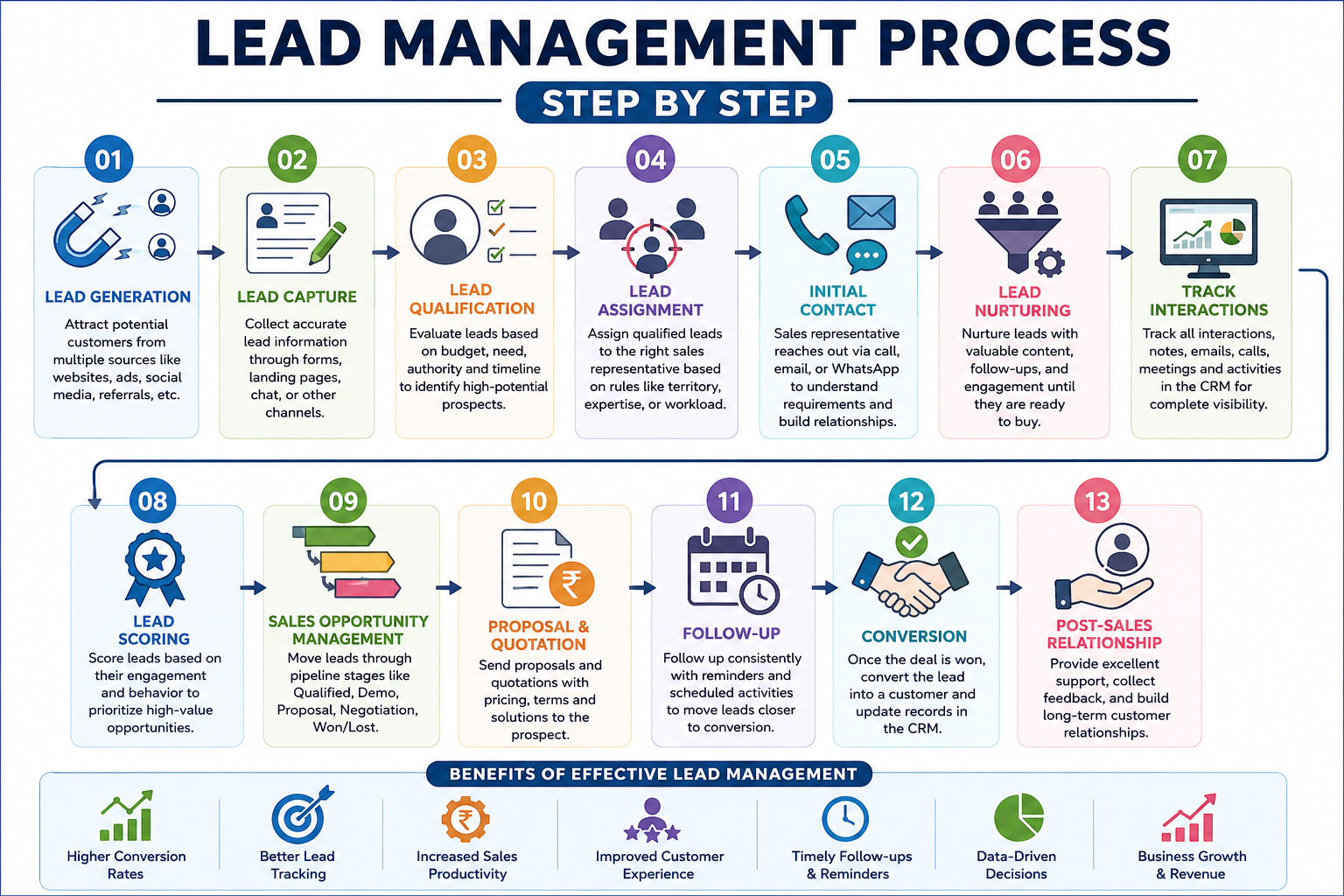
Lead Management Process Explained Step by Step: The Complete Guide for Businesses (2026)
In today's competitive business environment, generating leads is only the beginning of the sales journey. The real challenge lies in managing those leads efficiently until they become paying customers. Many businesses invest heavily in marketing campaigns but lose potential customers because they lack a structured lead management process.
An effective lead management process helps businesses capture, organise, qualify, nurture, and convert leads while ensuring that no opportunity is missed. Whether you're a startup, SME, or large enterprise, implementing the right lead management strategy can significantly improve your sales performance, customer relationships, and revenue.
Modern AI-powered CRM solutions such as iSaral AI CRM make this process even more efficient by automating repetitive tasks, tracking customer interactions, and providing valuable insights that help sales teams focus on the right prospects.
In this comprehensive guide, we'll explain the complete lead management process step by step and explore best practices that can help your business increase conversions.
What Is Lead Management?
Lead management is the systematic process of capturing, tracking, qualifying, nurturing, and converting potential customers into paying clients.
Instead of manually managing enquiries through spreadsheets or scattered WhatsApp messages, businesses use CRM software to organise every lead and monitor its progress through the sales pipeline.
- Every enquiry is recorded
- Leads are assigned to the right salesperson
- Follow-ups happen on time
- Customer communication is tracked
- Sales opportunities are never missed
Why Is Lead Management Important?
Without a structured process, businesses often experience recurring problems that quietly drain revenue.
- Missed follow-ups
- Duplicate customer records
- Poor customer experience
- Low conversion rates
- Inefficient sales teams
- Revenue leakage
- Increased lead conversion rates
- Improved sales productivity
- Enhanced customer satisfaction
- Data-driven decisions
- Automated repetitive sales activities
- Shorter sales cycle
The 13-Step Lead Management Process
Here's the complete lead management process broken down step by step, from first enquiry to long-term customer relationship.
Everything begins with generating potential customer enquiries. Leads can come from multiple sources, including:
- Company website & landing pages
- Facebook Ads, Google Ads, LinkedIn campaigns
- WhatsApp enquiries & email campaigns
- Trade exhibitions & customer referrals
- Organic search traffic
After generating interest, businesses need to collect accurate customer information such as name, phone number, email address, company name, city, product interest, and source of enquiry.
Modern CRM systems automatically capture leads from website forms, WhatsApp, Facebook Lead Ads, Google Lead Forms, chatbots, and API integrations — reducing manual work and ensuring no enquiry is lost.
Not every lead is ready to purchase immediately. Lead qualification helps businesses identify high-potential prospects and prioritise sales efforts by evaluating:
- Budget — Can the customer afford the product or service?
- Authority — Is the person the decision-maker?
- Need — Does the customer genuinely require your solution?
- Timeline — When does the customer plan to buy?
Once qualified, leads should be assigned to the appropriate salesperson based on geographic location, industry, product interest, language, team workload, or sales expertise.
The first interaction creates the first impression. Sales representatives should contact new leads quickly through phone calls, WhatsApp messages, email, SMS, or video meetings.
During the initial conversation: understand customer requirements, introduce your solution, build trust, and schedule the next discussion.
Many customers are not ready to purchase immediately. Lead nurturing involves maintaining regular communication until the customer is ready to make a buying decision.
- Educational emails & WhatsApp updates
- Product demonstrations & free consultations
- Case studies & success stories
- Product videos & industry insights
Every customer interaction should be recorded inside your CRM — phone calls, emails, WhatsApp conversations, meetings, notes, quotations, and documents shared.
Having a complete interaction history allows any team member to continue conversations seamlessly and provide better customer service.
Lead scoring helps businesses prioritise customers who are most likely to convert, based on website visits, email engagement, product enquiries, demo requests, budget, authority, and buying timeline.
Once a lead shows serious buying intent, it becomes a sales opportunity that moves through defined pipeline stages.
| Stage | Description |
|---|---|
| New Lead | Enquiry captured, not yet contacted |
| Contacted | Initial outreach completed |
| Qualified | Meets budget, authority, need, timeline |
| Demo Scheduled | Product walkthrough arranged |
| Proposal Sent | Pricing and quotation shared |
| Negotiation | Terms being discussed |
| Won | Deal closed successfully |
| Lost | Opportunity did not convert |
Visual sales pipelines help managers monitor deal progress and identify bottlenecks.
Customers interested in your solution typically request pricing information. Businesses should prepare professional quotations, product brochures, pricing details, implementation plans, and service agreements.
Most sales require multiple follow-ups before conversion. Successful businesses use structured follow-up schedules, for example:
- Day 1 — Thank-you message
- Day 3 — Product information
- Day 7 — Customer call
- Day 14 — Demo reminder
- Day 21 — Special offer
Once the customer agrees to purchase, the lead becomes a customer. The CRM should automatically update the customer database, sales reports, revenue dashboard, invoice details, and support records — creating a seamless transition from sales to customer service.
Lead management doesn't end after the sale. Businesses should continue engaging customers through product training, customer support, feedback collection, renewal reminders, cross-selling, upselling, and loyalty programmes.
Common Lead Management Challenges
Businesses frequently face challenges such as:
- ✕Delayed Follow-Ups — Leads go cold while waiting for a response
- ✕Duplicate Leads — The same enquiry logged multiple times
- ✕Poor Communication — Inconsistent messaging across the team
- ✕Manual Data Entry — Time-consuming and error-prone
- ✕Missing Customer Information — Incomplete records slow down sales
- ✕Lack of Sales Visibility — Managers can't see what's really happening
- ✕Unclear Pipeline Status — Hard to know which deals need attention
- ✕Low Conversion Rates — The end result of the issues above
Best Practices for an Effective Lead Management Process
To maximise results, businesses should:
- 1Use a Centralised CRM System — One source of truth for every lead
- 2Respond to Enquiries Quickly — Speed is a major conversion driver
- 3Automate Lead Capture — Eliminate manual entry and missed enquiries
- 4Implement Lead Scoring — Focus effort on the most promising leads
- 5Track Every Customer Interaction — Build a complete conversation history
- 6Schedule Timely Follow-Ups — Never let a lead go cold
- 7Monitor Sales Pipeline Performance — Spot bottlenecks early
- 8Train Sales Teams Regularly — Keep skills and processes sharp
- 9Analyse Conversion Metrics — Make decisions based on real data
- 10Use AI to Automate Repetitive Tasks — Free up time for relationship building
How AI CRM Improves Lead Management
AI-powered CRM platforms like iSaral AI CRM simplify the entire lead management process by automating the heavy lifting so sales teams can focus on building relationships and closing more deals.
Automatic Capture
Captures leads automatically from websites, ads, and WhatsApp.
Smart Assignment
Assigns leads to the right sales representatives instantly.
Automated Follow-Ups
Sends automated follow-up reminders so no lead is forgotten.
Unified Conversations
Tracks customer conversations in one central place.
AI-Based Scoring
Prioritises leads most likely to convert.
Real-Time Reports
Monitors pipeline performance and generates live dashboards.
Conclusion
An effective lead management process is the foundation of a successful sales strategy. From generating leads to converting them into loyal customers, every stage plays an important role in improving customer experience and increasing revenue.
Businesses that rely on manual spreadsheets or disconnected communication channels often struggle with missed opportunities, delayed follow-ups, and lower conversion rates. Implementing a structured lead management process supported by an AI-powered CRM helps streamline operations, improve collaboration, and ensure every lead receives timely attention.
Why Choose iSaral for Your Lead Management?
At iSaral.ai, we build AI CRM solutions that help businesses capture, qualify, and convert leads without letting a single opportunity slip through the cracks.
AI-Powered Lead Management
A centralised CRM that captures, scores, assigns, and nurtures leads automatically.
Omnichannel Lead Capture
Capture and manage leads across website, ads, WhatsApp, and email in one place.
Frequently Asked Questions
What is the lead management process?
The lead management process is the structured approach to capturing, qualifying, nurturing, tracking, and converting potential customers into paying clients.
Why is lead management important?
It helps businesses organise sales activities, improve follow-ups, increase conversion rates, and deliver a better customer experience.
What are the main stages of lead management?
The key stages include lead generation, lead capture, qualification, assignment, nurturing, scoring, opportunity management, follow-up, conversion, and post-sales engagement.
How does AI improve lead management?
AI automates lead capture, lead scoring, follow-up reminders, conversation tracking, and reporting, allowing sales teams to work more efficiently and focus on high-potential opportunities.
Which businesses benefit from lead management software?
Almost every business that handles customer enquiries can benefit, including startups, SMEs, educational institutions, healthcare providers, manufacturers, real estate firms, retail businesses, and service companies.
Build a Lead Process That Never Misses
Get expert guidance on implementing a lead management process and AI CRM for your business.
Custom CRM Strategy
Personalized roadmap for your specific industry and use case
Pipeline & Scoring Setup
Learn proven strategies for qualifying and prioritising leads
Implementation Support
Expert guidance from deployment through optimization
Continuous Improvement
Ongoing monitoring and enhancement of your sales pipeline
Explore More Resources
How AI CRM Helps Close More Sales
Learn how AI-powered CRM increases conversion rates, shortens sales cycles, and improves revenue.
📧 MarketingMarketing Automation Complete Guide
Master marketing automation to nurture leads, increase engagement, and drive conversions at scale.
💬 SupportHow AI Chatbots Transform Customer Support
Discover how AI chatbots improve support quality, reduce costs, and increase customer satisfaction.