
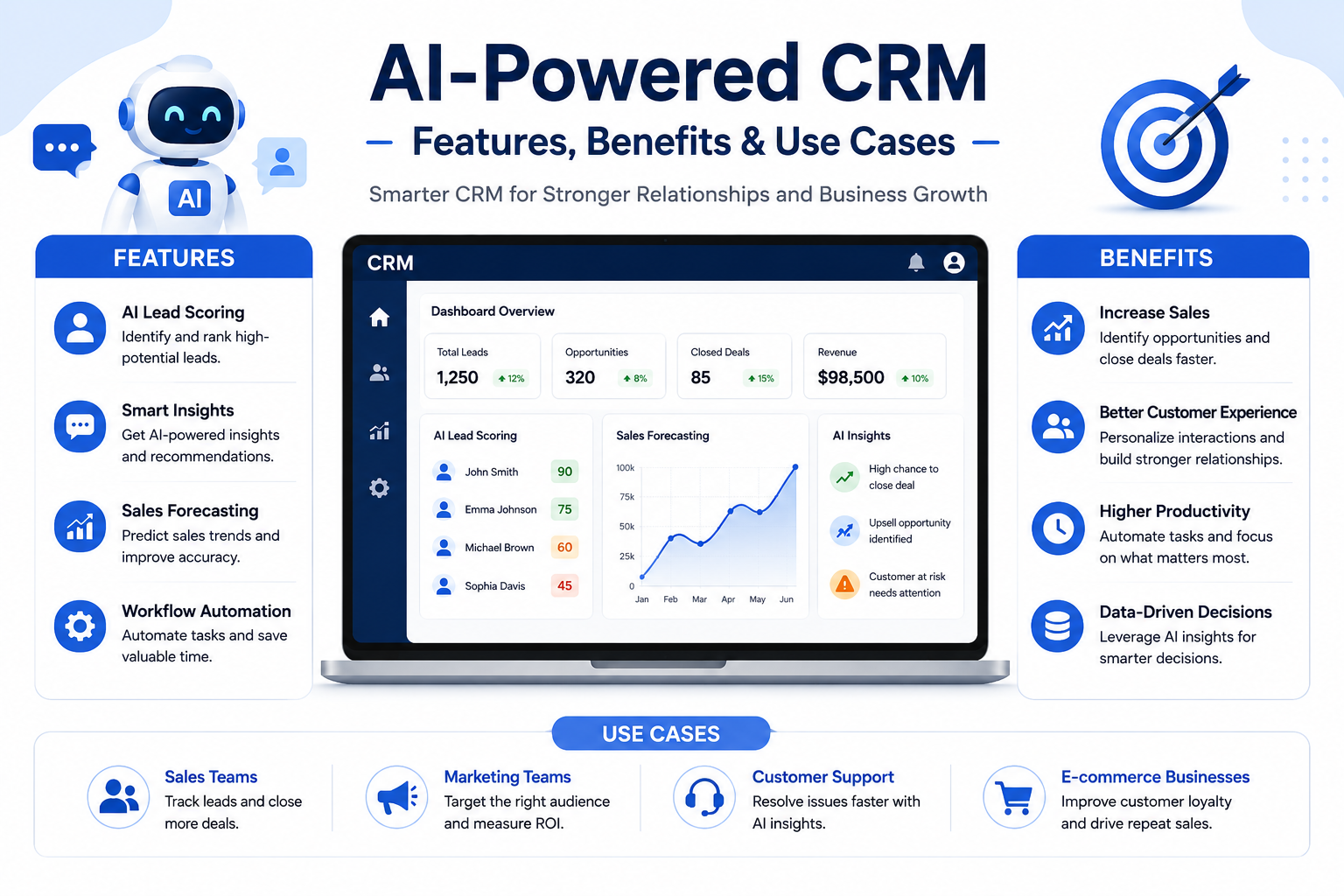
AI-Powered CRM: Features, Benefits and Use Cases
Customer relationship management has become an important part of modern business operations. As companies manage more customers, leads, conversations, and sales activities, traditional CRM systems are increasingly being enhanced with artificial intelligence.
An AI-powered CRM combines traditional customer relationship management with AI technologies to help businesses automate repetitive tasks, understand customer data, improve sales processes, and make faster decisions.
For small businesses as well as growing organizations, AI-powered CRM can help sales and customer-service teams spend less time on manual activities and more time building valuable customer relationships.
What Is an AI-Powered CRM?
An AI-powered CRM is a customer relationship management system that uses artificial intelligence and automation to analyze customer information and assist teams with sales, marketing, and customer-service activities.
Traditional CRM systems primarily store and organize customer information. AI-powered CRM systems can go further by identifying patterns, generating insights, automating workflows, and helping users decide what action to take next.
How Does an AI-Powered CRM Work?
An AI-powered CRM collects information from different customer interactions and business activities. This information can include:
- Customer profiles
- Lead information
- Sales activities
- Emails and messages
- Customer interactions
- Previous purchases
- Follow-up history
- Website or campaign activity
AI algorithms can analyze this information to identify patterns and provide useful recommendations. Instead of simply displaying customer data, the CRM can help employees understand the data and take appropriate action.
Key Features of an AI-Powered CRM
AI can help businesses organize and prioritize leads based on their characteristics, interactions, and engagement. Sales teams can identify leads that are more likely to become customers and focus their efforts where they can have the greatest impact.
Not every lead has the same level of interest or buying potential. AI can analyze available lead information and help businesses classify leads according to their potential, allowing sales teams to spend more time on high-quality opportunities.
Following up with leads at the right time is essential for successful sales. AI-powered CRM automation can help schedule reminders, trigger follow-up activities, and maintain consistent communication with prospects — reducing the possibility of leads being forgotten.
AI can analyze large amounts of customer information much faster than manual analysis. Businesses can use these insights to understand customer behavior, identify trends, and make better decisions.
AI can analyze historical sales information and current sales activities to help businesses understand potential future sales performance. Sales managers can use these insights for planning, target setting, and resource allocation.
Sales and support teams often spend considerable time reviewing previous customer conversations. AI can summarize important information from customer interactions, helping employees quickly understand the customer's requirements and history.
AI can help businesses understand customer preferences and previous interactions. Using these insights, businesses can provide more relevant communication, recommendations, and offers to different customer segments.
AI-powered CRM systems can automate repetitive tasks such as assigning leads, creating reminders, updating records, and triggering notifications. Automation allows employees to focus on higher-value activities.
Benefits of an AI-Powered CRM
Increased Productivity
Automating routine activities allows sales and customer-service teams to focus more on selling, problem-solving, and customer relationships.
Better Lead Conversion
AI helps sales teams prioritize follow-ups so the right leads get attention at the right time, improving the chances of closing.
Faster Decision-Making
Managers can use AI-generated insights to understand important trends and make faster decisions instead of manually reviewing data.
Improved Customer Experience
Employees get relevant customer information when they need it, helping teams deliver more personalized, consistent interactions.
Reduced Manual Work
Data entry, reminders, lead assignment, and follow-ups can be automated, saving time and reducing errors from manual processes.
Better Sales Visibility
Centralized dashboards and reports give managers a clearer view of leads, opportunities, and performance across the pipeline.
AI-Powered CRM Use Cases
AI-powered CRM technology can be useful across different areas of a business.
Sales Teams
Prioritize leads, automate follow-ups, track opportunities, and forecast potential sales.
Marketing Teams
Understand customer segments, personalize campaigns, and identify engaged leads.
Customer Support
Access customer history, summarize interactions, and provide faster responses.
Small Businesses
Manage more customers without increasing manual administrative work.
Growing Businesses
Organize expanding customer and sales data as the business scales.
Cross-Team Collaboration
Centralized, AI-enriched data keeps sales, marketing, and support aligned.
AI-Powered CRM vs Traditional CRM
Traditional CRM systems primarily focus on storing and managing customer information. AI-powered CRM adds intelligence and automation to that information.
| Capability | Traditional CRM | AI-Powered CRM |
|---|---|---|
| Customer Information | Stores customer information | Analyzes customer information |
| Follow-Ups | Manual follow-ups | Automated follow-up workflows |
| Reporting | Basic reports | AI-assisted insights |
| Lead Prioritization | Manual lead prioritization | Intelligent lead prioritization |
| Data Analysis | Manual data analysis | Automated pattern analysis |
| Customer Interactions | Standard customer management | Personalized customer interactions |
How to Choose an AI-Powered CRM
Before selecting an AI-powered CRM, businesses should consider their specific requirements.
- 1Identify Your Business Needs — Determine whether your main requirement is lead management, sales automation, customer support, marketing, or a combination of these.
- 2Check Automation Capabilities — Look for features that can automate lead assignment, reminders, follow-ups, and workflow management.
- 3Consider Ease of Use — A CRM should be easy for employees to understand. A complicated system reduces adoption across the organization.
- 4Evaluate Reporting and Analytics — Choose a system that provides useful dashboards, reports, and insights for monitoring performance.
- 5Consider Scalability — Your CRM should support your business as customers, employees, and sales activities increase.
- 6Review Data Security — Make sure the CRM provides appropriate security and access controls for your organization's requirements.
Common Challenges of AI-Powered CRM
Although AI-powered CRM provides many benefits, businesses should also consider potential challenges.
- Data quality — AI insights depend on accurate, complete data
- Employee adoption — proper training is required to use new features
- Integration — connecting with existing business applications
- Privacy and security — managing sensitive customer information
- Establish regular data hygiene and cleanup routines
- Provide structured onboarding and hands-on training
- Plan integration requirements before implementation
- Set clear access-control policies for customer data
Bring AI Into Your Customer Relationships
Get expert guidance to set up your AI-powered CRM, automate lead management, and convert more customers faster.
CRM Assessment
Evaluate your current customer data and sales process
AI Strategy
Custom roadmap for lead scoring, automation, and insights
Implementation Support
End-to-end setup, configuration, and testing
Team Training
Comprehensive training for your sales and support teams
Conclusion
An AI-powered CRM combines customer relationship management with artificial intelligence, automation, and data-driven insights. It can help businesses manage leads, automate follow-ups, understand customer behavior, improve sales productivity, and deliver better customer experiences.
As businesses continue to adopt AI technologies, intelligent CRM systems can play an important role in creating more efficient sales and customer-management processes.
If you're ready to modernize how you manage customer relationships, iSaral AI can help you implement an AI-powered CRM tailored to your business needs.
Frequently Asked Questions
What is an AI-powered CRM?
An AI-powered CRM is a customer relationship management system that uses artificial intelligence to analyze customer data, automate tasks, provide insights, and support sales and customer-service activities.
What are the main benefits of AI-powered CRM?
The major benefits include improved productivity, automated workflows, better lead prioritization, faster decision-making, improved customer experiences, and better visibility into sales activities.
Can small businesses use AI-powered CRM?
Yes. AI-powered CRM can be particularly useful for small businesses because automation can reduce repetitive work and help small teams manage customer relationships more efficiently.
Can AI CRM improve lead conversion?
AI can help sales teams prioritize leads, identify engagement patterns, and automate follow-ups. These capabilities can support a more efficient lead-conversion process.
Is AI-powered CRM better than traditional CRM?
AI-powered CRM adds intelligence, automation, and advanced analysis to traditional CRM capabilities. However, the best solution depends on the specific needs, size, and processes of each business.
Explore More Resources
How CRM Helps Track Sales Pipeline and Close More Deals
Learn how CRM software helps businesses track pipelines, automate lead management, and close more deals faster.
🤖 AI + CRMWhy 80% of Small Businesses Waste Time on WhatsApp
Discover how to streamline your communication and boost productivity with AI-powered CRM integration.
🎯 Lead GenHow AI CRM Helps Close More Sales
A complete guide to using AI-driven lead scoring and automation to convert more prospects.