
How AI Chatbots and CRM Work Together to Improve Customer Experience
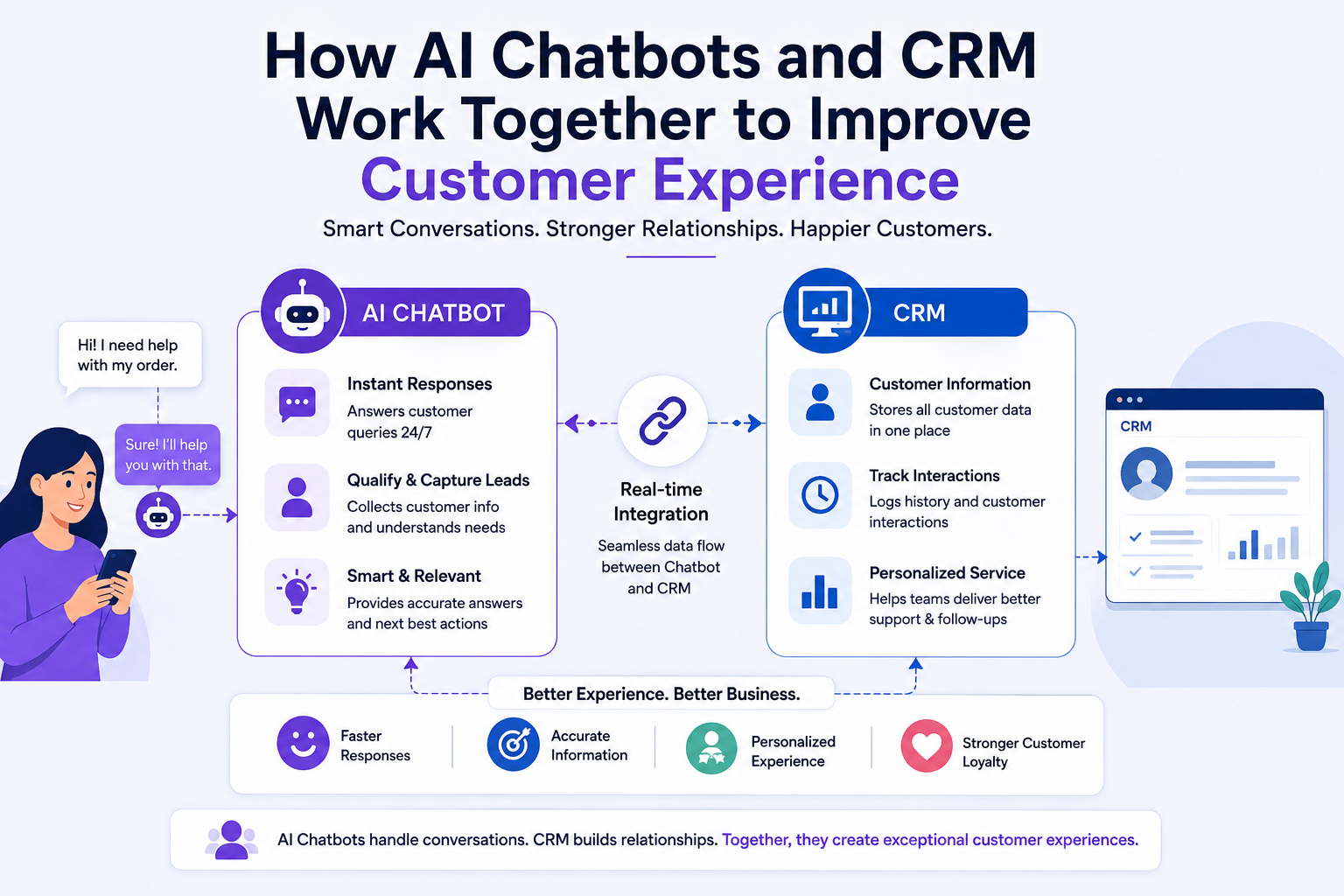
In today's competitive business landscape, delivering exceptional customer experiences is essential for growth. Customers expect instant responses, personalized interactions, and seamless support across multiple channels. This is where AI chatbots and Customer Relationship Management (CRM) systems become powerful business tools.
When AI chatbots are integrated with a CRM platform, businesses can automate customer interactions, capture valuable customer data, improve lead management, and provide personalized support around the clock. This combination not only enhances customer satisfaction but also helps sales and marketing teams work more efficiently.
In this article, we'll explore how AI chatbots and CRM work together to improve customer experience and drive business success.
What Is an AI Chatbot?
An AI chatbot is an intelligent virtual assistant that uses Artificial Intelligence (AI) and Natural Language Processing (NLP) to understand customer queries and provide relevant responses. Unlike traditional chatbots that rely on predefined scripts, AI chatbots learn from conversations and continuously improve their responses.
- Customer support and troubleshooting
- Lead generation and qualification
- Appointment booking and scheduling
- Product recommendations and upselling
- Order tracking and status updates
- Answering frequently asked questions
- Customer feedback collection
What Is a CRM System?
A Customer Relationship Management (CRM) system helps businesses organize and manage customer information, sales activities, communication history, and marketing campaigns in one centralized platform. A CRM enables businesses to understand each customer better and deliver more personalized experiences.
Centralized Customer Data
Store all customer details, interaction history, and communication records in one unified platform.
Sales Pipeline Management
Monitor leads, opportunities, and deals as they move through your sales funnel.
Automated Workflows
Set up automatic follow-ups, reminders, and task assignments for your team.
Customer Insights
Track customer retention, measure satisfaction, and identify opportunities for improvement.
Popular CRM platforms include Salesforce, HubSpot, Zoho CRM, and Microsoft Dynamics 365. Each offers unique features tailored to different business sizes and industries.
How AI Chatbots and CRM Work Together
When connected, AI chatbots and CRM systems create a powerful synergy that automates and enhances the entire customer journey. Here's how they work together:
The chatbot collects customer names, contact details, company information, and specific requirements during conversations. This data is automatically saved to the CRM.
AI chatbots ask qualifying questions to determine a prospect's needs, budget, and timeline. These insights help the CRM prioritize leads for the sales team.
Every chatbot conversation is logged and linked to the customer's CRM profile, creating a complete interaction record that informs future communications.
The CRM automatically routes qualified leads to the appropriate sales representatives based on territory, expertise, or availability.
The system automatically schedules follow-up activities, sends reminders, and tracks engagement metrics for each interaction.
Key Benefits of Integrating AI Chatbots with CRM
1. 24/7 Customer Support Without Added Costs
AI chatbots provide instant support even outside business hours. Customers receive immediate answers without waiting for a human representative, improving satisfaction while reducing support team workload.
- Instant response to queries
- 24/7 availability
- No wait times
- Consistent support quality
- Reduced support costs
- Higher customer satisfaction
- Faster resolution times
- Support team focuses on complex issues
2. Automatic Lead Generation and Qualification
Every website visitor becomes a potential customer. AI chatbots engage visitors in real-time, ask qualifying questions, and collect important information such as name, email, phone number, business type, and requirements. This data flows directly into the CRM for lead scoring and prioritization.
3. Personalized Customer Experiences
Since the chatbot has access to customer CRM data, it can personalize conversations based on previous interactions, purchase history, and preferences. This creates meaningful customer relationships and increases trust.
Instead of generic responses, the chatbot can say:
"Welcome back, Sarah! I see you recently inquired about our AI automation platform. Would you like to continue where we left off, or do you have new questions?"
This level of personalization builds trust and significantly improves conversion rates.
4. Faster and Smarter Sales Process
AI chatbots qualify leads before transferring them to sales teams, significantly improving sales efficiency. They determine:
- ✓Budget availability and spending capacity
- ✓Company size and organizational structure
- ✓Industry and business vertical
- ✓Purchase intent and urgency level
- ✓Key pain points and requirements
Sales representatives receive qualified leads with complete context, enabling more informed and productive follow-up conversations.
5. Better Customer Insights and Business Intelligence
Every customer interaction through the chatbot is captured, analyzed, and stored in the CRM. This provides valuable insights such as:
Frequent Questions
Identify commonly asked questions to improve your website FAQ and documentation
Customer Preferences
Understand what features and services customers value most
Buying Behavior
Track decision timelines and factors that influence purchase decisions
Pain Points
Discover challenges customers face that your product should address
Objections
Understand reasons prospects hesitate so you can address them proactively
Trends
Spot emerging trends and opportunities in your market
These insights help improve products, refine marketing messages, and create more effective sales strategies.
6. Automated Follow-Ups and Engagement
Following up with leads manually is time-consuming and error-prone. When AI chatbots integrate with CRM, they automatically:
- Send personalized follow-up messages at optimal times
- Share relevant product brochures and case studies
- Schedule meetings and demos with sales team members
- Send promotional offers and special deals
- Collect customer feedback and satisfaction surveys
- Re-engage inactive customers with targeted content
Automation ensures consistent engagement while freeing your team to focus on high-value activities.
7. Improved Marketing Campaign Performance
CRM data combined with chatbot conversation insights enables marketers to create highly targeted campaigns. Businesses can segment customers based on:
| Segmentation Factor | Use Case | Campaign Example |
|---|---|---|
| Industry & Company Size | Tailor messaging to business context | "Solutions for mid-market SaaS companies" |
| Purchase History | Recommend complementary products | Upsell to existing customers |
| Website & Chatbot Activity | Identify hot prospects | Prioritize sales outreach |
| Previous Interactions | Personalize email content | Address previous objections |
| Engagement Level | Re-engagement campaigns | Win-back offers for inactive leads |
This targeted approach leads to higher open rates, click-through rates, and conversion rates compared to generic email campaigns.
8. Reduced Operational Costs
AI chatbots handle thousands of customer conversations simultaneously, reducing the need for large support teams. Businesses can:
- $Reduce customer support labor costs by up to 60%
- $Improve operational efficiency and team productivity
- $Allow employees to focus on strategic, high-value work
- $Scale customer service without proportional staffing increases
Real-World Example: Customer Journey with AI Chatbot + CRM
Imagine a visitor lands on an AI solutions website looking for workflow automation tools:
The AI chatbot greets the visitor instantly with a personalized welcome message and offers to help.
The chatbot asks about their business needs, current challenges, and requirements. Based on responses, the chatbot determines their ideal solutions.
Chatbot collects contact information, company details, budget, and timeline. All data is automatically saved to the CRM.
The CRM automatically qualifies the lead as "high-quality" and routes it to the appropriate sales representative based on industry expertise.
The sales team receives a message with the complete conversation history and lead qualification details, enabling an informed and relevant sales call.
If the lead isn't ready to buy, the CRM automatically sends relevant content, case studies, and updates to keep the prospect engaged.
Best Practices for AI Chatbot and CRM Integration
To maximize the benefits of integrating AI chatbots with your CRM:
- 1Integrate with Your CRM Platform — Ensure seamless data flow between chatbot and CRM systems
- 2Use AI to Personalize — Train chatbots with customer data for highly relevant conversations
- 3Keep Customer Data Updated — Regular CRM data hygiene ensures accuracy and relevance
- 4Automate Routine Follow-Ups — Let the system handle repetitive tasks automatically
- 5Monitor Performance Regularly — Track chatbot response rates, lead quality, and conversion metrics
- 6Train Chatbot Continuously — Regularly update with FAQs, new products, and customer feedback
- 7Enable Smooth Human Handoff — Ensure seamless transition from chatbot to human agent when needed
- 8Prioritize Data Privacy — Ensure GDPR and data protection compliance in chatbot interactions
The Future of AI Chatbots and CRM Integration
As AI technology continues to advance, the integration of chatbots and CRM systems will become even more sophisticated:
Predictive Support
AI predicts customer needs before they arise, offering proactive solutions
Voice AI Assistants
Voice-enabled chatbots for hands-free customer interaction
Sentiment Analysis
Advanced emotional intelligence to detect customer frustration and escalate
Smart Recommendations
Hyper-personalized product suggestions based on behavior and preferences
Revenue Forecasting
AI-powered sales forecasting for better pipeline management
Deeper Automation
Complete CRM automation from lead capture through customer advocacy
Businesses that adopt AI-driven CRM solutions today will be better positioned to deliver exceptional customer experiences in the future.
Integrate AI Chatbots with Your CRM
Get expert guidance to connect your chatbot and CRM, automate lead management, and transform customer interactions.
Platform Assessment
Evaluate your current CRM and chatbot capabilities
Integration Strategy
Custom roadmap for seamless chatbot-CRM connection
Implementation Support
End-to-end setup, configuration, and testing
Team Training
Comprehensive training for your sales and support teams
Conclusion
AI chatbots and CRM systems complement each other by combining intelligent customer interactions with centralized customer data. Together, they help businesses automate support, capture qualified leads, personalize communication, and improve customer satisfaction significantly.
Whether you're a startup or an established enterprise, integrating AI chatbots with your CRM can streamline operations, enhance customer relationships, and drive sustainable business growth. The combination enables faster sales cycles, better customer insights, and more efficient team workflows.
If you're ready to modernize your sales and customer engagement strategy, iSaral AI can help you implement an integrated AI chatbot and CRM solution tailored to your business needs.
Frequently Asked Questions
What is the main benefit of integrating AI chatbots with CRM?
The main benefit is automating the entire customer journey while capturing and organizing customer data. This creates seamless handoffs between marketing, sales, and support teams while providing personalized customer experiences.
How does a chatbot capture data for the CRM?
During conversations, chatbots collect customer information through natural conversation flow. Responses are automatically formatted and stored in the CRM with no manual data entry required.
Can I integrate an AI chatbot with my existing CRM?
Yes, most modern AI chatbots can integrate with popular CRM platforms like Salesforce, HubSpot, Zoho, and Microsoft Dynamics through APIs and native integrations.
How does AI personalization work in chatbot-CRM integration?
The chatbot accesses customer data from the CRM, including previous interactions, purchase history, and preferences, and uses this to tailor conversations and recommendations in real-time.
What happens when a chatbot conversation ends?
All conversation data is automatically logged in the CRM. If the prospect is qualified, they're routed to the appropriate sales representative with complete conversation context for informed follow-up.
How does this integration improve lead quality?
Chatbots qualify leads through targeted questions, scoring interactions based on buying signals. This ensures sales teams focus only on genuinely interested, well-qualified prospects.
Is chatbot-CRM integration suitable for B2B and B2C businesses?
Yes, both B2B and B2C businesses benefit significantly. B2B uses it for lead qualification and account-based marketing, while B2C uses it for customer support and retention.
Explore More Resources
Why Every Business Needs AI Workflow Automation
Complete guide to automating business processes with AI for efficiency and cost savings.
💬 SupportHow AI Chatbots Transform Customer Support
Explore how AI chatbots improve response times, customer satisfaction, and support costs.
🎯 Lead GenHow to Generate Qualified Leads Online
Strategic guide to attracting, qualifying, and converting high-value prospects.