
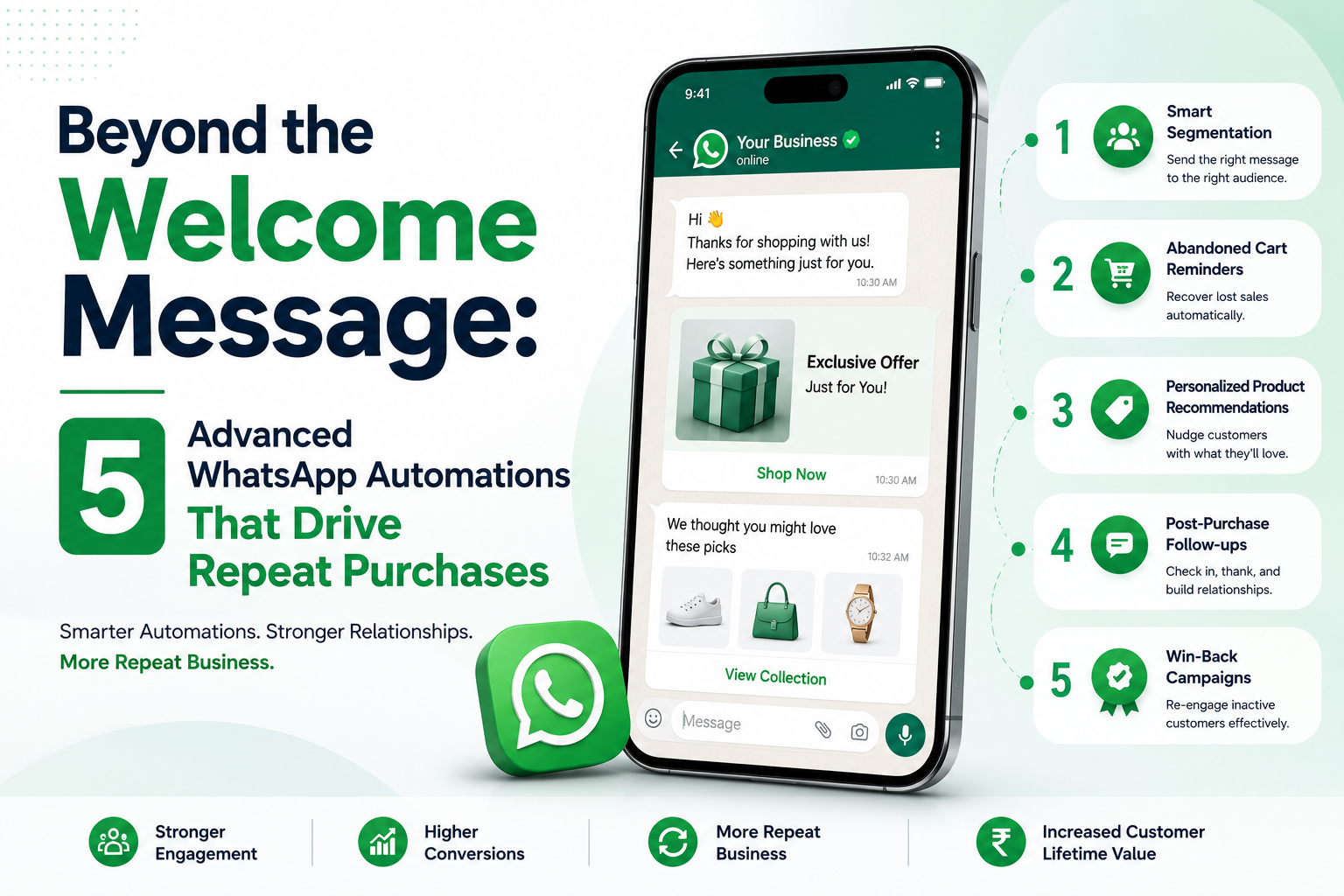
Most e-commerce brands set up a WhatsApp welcome message, feel good about it, and stop there. That's a mistake — and it's quietly costing them repeat sales. While the initial opt-in is crucial, it's only the beginning of a potential lifelong relationship. If you aren't nurturing your customers past that first "hello," you're leaving significant revenue on the table.
This guide is for e-commerce store owners, retention marketers, and DTC brand operators who already have basic WhatsApp messaging in place and want to do more with it. If you're sending the occasional broadcast but not seeing customers come back, the gap isn't your product — it's your automation strategy.
- Why welcome messages alone leave revenue on the table
- How repeat customers fuel exponential business growth
- 5 advanced automations that drive sustainable repeat purchases
- Timing, messaging, and psychology behind each automation
- How to build and optimize your WhatsApp automation stack
- Compliance and best practices for lasting customer relationships
Why Basic WhatsApp Automations Are Leaving Revenue on the Table
The Gap Between Welcome Messages and Revenue-Driving Automations
Welcome messages confirm a subscription — they don't drive long-term revenue. The real money lives deeper in the customer journey, in timely, personalized touchpoints that nudge people back to buy again. Without these advanced flows, your WhatsApp channel remains a cost center rather than a profit engine.
How Repeat Purchases Fuel Long-Term Business Growth
Consider these fundamental truths about customer economics:
- Acquisition costs dominate: It costs five times more to acquire a new customer than to keep an existing one
- Repeat buyers compound: When a customer buys twice, their likelihood of buying a third time jumps significantly
- Revenue becomes predictable: Repeat purchases build stable revenue, reduce paid ad dependence, and fuel organic referrals
By automating the retention process, you ensure no customer falls through the cracks. Every automated interaction drives lifetime value, margins, and insights about buying patterns you can act on.
Automation 1: Personalized Replenishment Reminders That Bring Customers Back
Identifying the Right Moment to Trigger a Replenishment Message
Timing is everything. A replenishment reminder sent too early feels presumptuous; too late, and your customer has already bought from a competitor. The sweet spot sits just before a product runs out — typically 80–90% through its average consumption cycle.
For example, if a vitamin supply lasts 30 days on average, trigger the message on day 25. This timing:
- Catches customers before urgency disappears
- Avoids aggressive, pushy messaging
- Creates a helpful, service-oriented impression
Crafting Messages That Feel Helpful Rather Than Pushy
The difference between a helpful nudge and an annoying sales pitch comes down to tone and relevance. Lead with genuine value — remind them they're probably running low and make reordering dead simple with a direct link.
Example Replenishment Message
"Hey Sarah 👋 Your Vitamin C serum is probably getting low! Tap here to reorder in one click — we'll have it to you by Thursday." This feels like a service, not a solicitation.
Automation 2: Post-Purchase Upsell Sequences That Feel Natural
Timing Your Upsell Message for Maximum Receptiveness
The sweet spot for a post-purchase upsell is roughly 2–5 days after delivery confirmation. At that point, your customer has unboxed the product, tried it, and is still riding that feel-good wave. Don't blast an upsell the second they check out; wait for the product experience to settle in.
Bundling Complementary Products to Increase Average Order Value
Pairing products that genuinely belong together makes the upsell feel like helpful advice, not a sales tactic. Think:
- Shampoo + conditioner
- Protein powder + shaker bottle
- Serum + moisturizer
Keep the bundle tight — two to three products max. Overwhelming customers with too many choices leads to decision fatigue.
Using Conversational Tone to Drive Clicks Without Pressure
Avoid aggressive pitch language. On WhatsApp, soft CTAs like "Want to check it out?" or "Should I grab a link for you?" feel like a conversation.
Example Upsell Message
"Hey [Name]! Glad your new serum arrived 🙌 A lot of customers pair it with our hydrating mist — it makes a real difference. Want a quick look?" Much more effective than "LIMITED OFFER! BUY NOW!"
Automation 3: Win-Back Campaigns for Lapsed Customers
Defining the Right Inactivity Window to Trigger a Win-Back Flow
Not every quiet customer is a lost one. Your inactivity window needs to match your product's natural purchase cycle.
| Product Type | Typical Reorder Cycle | Trigger Window |
|---|---|---|
| Consumables (skincare, supplements) | 30-45 days | 45-60 days of silence |
| Beauty products | 60 days | 90 days of silence |
| High-ticket items | 6-12 months | 9-18 months of silence |
Using Multi-Step Sequences to Recover Lost Customers Gradually
One message rarely wins anyone back. A solid three-step flow works best:
Day 1: Soft Check-In (No Discount)
Simply re-establish the relationship without asking for the sale. "We miss you! How have you been?" signals genuine care.
Day 4: Value Reminder (A Tip or Update)
Share a tip, product update, or useful content. This rebuilds trust and reminds them why they loved you initially.
Day 8: Incentive Offer (Discount or Free Shipping)
Now offer a meaningful incentive. This gradual approach makes the final offer feel earned, not desperate.
Automation 4: Loyalty Milestone Alerts That Reward and Retain
Delivering Exclusive Rewards That Make Customers Feel Valued
When a customer hits a milestone—a spending threshold (e.g., $250) or a purchase count (e.g., their 5th order)—trigger a celebratory message. Deliver something worth opening: a personalized discount code, early access to a new collection, or a free gift. Addressing them by name and acknowledging their specific milestone creates a moment of delight that generic promos can't match.
Turning Milestone Moments Into Referral Opportunities
A milestone message is a peak-engagement moment. Customers feel appreciated, which makes them primed to talk about you. Drop a simple referral prompt right inside the message:
Example Milestone + Referral Message
"🎉 You just hit 5 purchases! Thanks for being awesome. Enjoy 20% off your next order. Share your code with a friend and you both save 15%." This transforms loyalty into a low-cost acquisition channel.
Automation 5: Abandoned Cart Recovery Flows That Actually Convert
Addressing Objections Through Smart Message Sequencing
Abandoned carts aren't just accidents; they are often the result of hesitation. A strategic sequence tackles different psychological barriers:
First Message (30-60 Minutes)
A friendly reminder with the cart contents and a direct checkout link. Timing is crucial—strike while intent is still hot.
Second Message (24 Hours)
Build trust with social proof ("1,200+ customers love this set") or a clear return policy. Address trust hesitation.
Third Message (48 Hours)
Address price hesitation with a small incentive. This is where you offer a discount or free shipping—but only at the end.
Offering Incentives Strategically Without Eroding Profit Margins
Throwing a discount at every abandoned cart trains customers to leave carts on purpose. Instead:
- Save incentives for the final message only
- Prioritize non-monetary options: free shipping, bonus samples, or loyalty points
- Set minimum thresholds: only discount carts above $50 to protect margins
Building and Optimizing Your Advanced WhatsApp Automation Stack
Choosing the Right Platform and Staying Compliant
Picking the right platform is key. You want a tool that connects with your CRM and offers visual flow builders. Platforms like Zoko or Interakt are great starting points for most brands. Remember to always respect user boundaries:
- Get explicit opt-ins before sending marketing messages
- Make "STOP" simple and immediate
- Run regular A/B tests on timing and tone
- Treat WhatsApp as a relationship tool, not a broadcast channel
Starting Your Automation Journey
The brands seeing the strongest repeat purchase rates treat WhatsApp as an ongoing relationship tool. Start with one automation that addresses your biggest gap today — whether that's recovering lost carts or re-engaging quiet customers — and build from there. Each step builds a more resilient, profitable business.
- Identify which automation solves your biggest current problem
- Map out your customer journey and key decision moments
- Set up simple A/B tests to optimize timing and messaging
- Monitor conversion metrics and iterate continuously
WhatsApp Automation Playbook
The complete system to turn WhatsApp into a retention and revenue machine. Includes all 5 automation templates, message sequences, timing frameworks, and optimization checklists that top DTC brands use to drive repeat purchases at scale.
5 Complete Automation Templates
Ready-to-use flows for every customer stage
Message Sequences & Timing
Proven copy and optimal send times
Customer Journey Mapping
Where to deploy each automation
A/B Testing Framework
How to optimize for maximum conversion
The Path to Sustainable Repeat Purchase Growth
Welcome messages are just the beginning. The real revenue lives in the automations that follow—the reminders that bring customers back, the upsells that increase order value, the win-backs that recover lost relationships, and the loyalty moments that inspire advocacy.
The data is clear: Repeat customers cost less to acquire, spend more over their lifetime, and refer friends at higher rates. By implementing these 5 advanced WhatsApp automations, you stop leaving revenue on the table and start building a predictable, sustainable growth engine.
Start with one automation today. Measure the results. Iterate based on what you learn. Each step compounds—and within months, you'll have a WhatsApp channel that drives meaningful repeat purchase growth. That's the path from welcome message to revenue powerhouse.