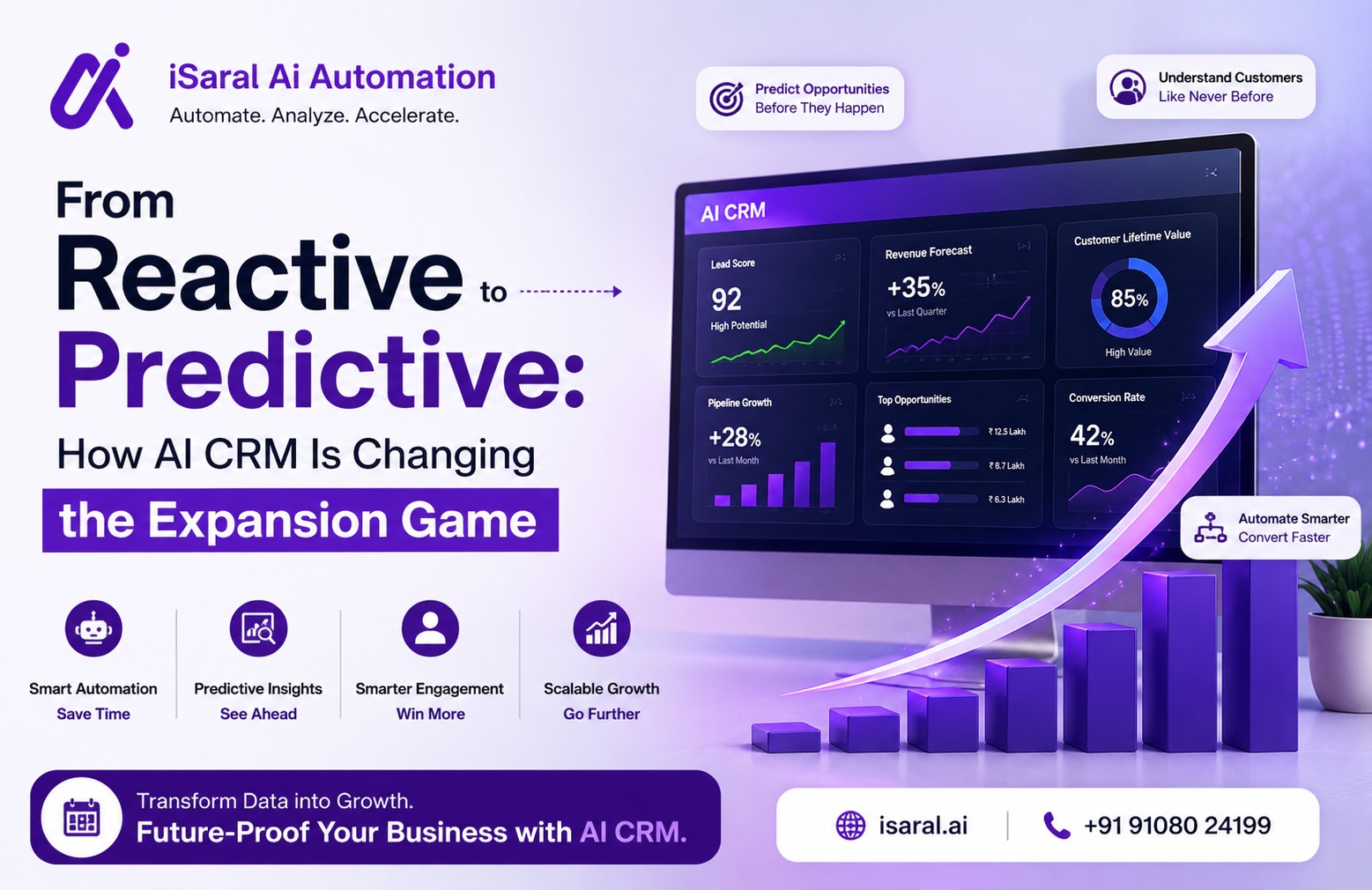
The Limitations of Reactive CRM in Modern Business Expansion
How Traditional CRM Leaves Revenue Opportunities on the Table
Most CRM systems are built to record what already happened — a closed deal, a lost account, a customer complaint. By the time your team logs the data and someone reviews it, the window to act has quietly closed. High-value accounts churn, upsell moments pass, and promising leads go cold while reps are busy updating fields instead of building relationships.
Delayed insights don't just feel frustrating — they carry a real price tag. When sales teams rely on last quarter's numbers to make today's decisions, they're essentially driving forward while staring at the rearview mirror. Missed renewals, poorly timed outreach, and misallocated sales resources all quietly drain revenue in ways that rarely show up cleanly on a single report.
Reactive Strategies Slow Down Global Growth
Expanding into new markets requires speed and precision — two things reactive CRM simply can't deliver. When your growth playbook depends on manually spotting trends, stitching together spreadsheets, or waiting for end-of-month reviews, you're already behind competitors who are acting on real-time signals.
Reactive strategies create lag at every stage, making it nearly impossible to move fast enough to win in unfamiliar territories. The cost isn't just a few missed deals — it's the compounding disadvantage of always playing catch-up.
What AI-Powered CRM Actually Means for Expansion Teams
Predictive Analytics vs. Conventional Reporting
Old-school CRM reporting tells you what already happened — deals closed last quarter, churn rates from six months ago, leads that went cold weeks before anyone noticed. Predictive analytics flips that entirely. Instead of looking backward, it scans current patterns and flags what's likely to happen next, giving expansion teams a genuine head start.
| Dimension | Conventional Reporting | Predictive Analytics |
|---|---|---|
| Data Orientation | Historical data only | Forward-looking signals |
| Interpretation | Manual, slow | Automated pattern recognition |
| Decision Style | Reactive | Proactive opportunity targeting |
| Dashboard Type | Static snapshots | Dynamic, real-time scoring |
How Machine Learning Transforms Customer Signals Into Action
Every customer interaction — a support ticket, a product login, a skipped renewal email — carries a signal. Machine learning stitches those signals together into a coherent story about intent. An expansion team using AI CRM doesn't have to guess which accounts are ready to grow; the system surfaces them automatically, ranked by likelihood and potential value.
Real-Time Intelligence That Scales Across Markets
Scaling into new geographies traditionally meant building local knowledge from scratch. AI CRM compresses that learning curve dramatically by processing market-specific behaviour data as it comes in. Teams get live scoring and recommendations that adapt to each region's buying patterns — without requiring separate manual analysis for every new territory.
CRM started as a glorified contact database. AI-powered CRM is something fundamentally different — it's a decision engine. Rather than storing customer data passively, it actively interprets that data and surfaces recommended next steps, priority accounts, and risk alerts directly inside the workflows expansion teams already use every single day.
Key Predictive Capabilities Driving Smarter Growth
What AI CRM Actually Does in the Real World
Forecast Customer Lifetime Value Before Commitment
AI CRM tools now predict how much a customer will spend over their entire relationship — before you've closed the deal. Analysing behavioural signals, purchase patterns, and firmographic data lets teams prioritise leads that will actually grow, not just convert.
Identify Expansion-Ready Accounts with Precision
Not every existing customer is ready to buy more. AI CRM flags accounts showing growth signals — increased product usage, team size changes, or support ticket patterns — so reps focus energy where expansion conversations will actually land.
Automate Upsell & Cross-Sell Timing
Timing is everything in expansion plays. AI watches how customers engage with your product and triggers upsell recommendations at exactly the right moment — when adoption peaks, a new use case emerges, or a customer milestone is hit.
Anticipate Churn Before It Disrupts Momentum
Predictive models watch for engagement drops, usage dips, and support patterns that historically precede churn — giving account teams a chance to intervene before a relationship quietly falls apart.
These capabilities don't operate in isolation. When forecasting, account identification, timing, and churn prevention all run simultaneously on the same data layer, expansion teams gain an intelligence advantage that compounds with every passing month — widening the gap between them and competitors still working from manual playbooks.
How AI CRM Accelerates Entry Into New Markets
Speed and Precision — the Two Things Reactive CRM Can't Deliver
Predictive Scoring to Prioritise High-Potential Territories
AI CRM tools analyse historical deal data, demographic signals, and market activity to score territories before you spend a single dollar entering them. Instead of guessing which regions look promising, your team gets a ranked list backed by real patterns — so you go where the money actually is, not just where it feels right.
Reducing Ramp Time for New Regional Sales Teams
New reps in unfamiliar markets usually spend months figuring out what works. AI CRM shortens that curve by surfacing winning playbooks, flagging which prospect types convert fastest locally, and auto-populating context that would otherwise take reps weeks to gather manually.
Personalising Outreach at Scale Without Losing Relevance
Scaling outreach typically means sacrificing personalisation — but AI CRM flips that trade-off. It pulls behavioural signals, buying stage data, and industry-specific triggers to help reps send messages that feel tailor-made, even when they're reaching hundreds of prospects across a new market simultaneously.
Aligning Marketing and Sales Around Shared Predictive Insights
When both teams work from the same AI-generated data — same scoring models, same territory insights, same lead priorities — campaigns and sales motions stop pulling in opposite directions. That alignment means faster pipeline build in new markets and fewer wasted handoffs between teams.
Losing early customers in a new market sends the wrong signal and drains resources fast. Predictive models watch for engagement drops and usage dips that historically precede churn — giving account teams a chance to intervene before a relationship quietly falls apart.
Measuring the Business Impact of Predictive CRM Adoption
Revenue Metrics That Reflect True Expansion Success
Tracking revenue in an AI CRM environment goes beyond watching total sales numbers climb. Teams now measure expansion MRR, net revenue retention (NRR), and customer lifetime value (CLV) with far greater accuracy because predictive models flag upsell opportunities before reps even make a call.
| Metric | Reactive CRM Approach | Predictive CRM Approach |
|---|---|---|
| Expansion MRR | Discovered after renewal conversations | 60–90 days flagged in advance |
| Net Revenue Retention | Calculated quarterly in retrospect | Monitored in real time with churn risk scores |
| Customer Lifetime Value | Static estimate at contract signing | Dynamically updated based on usage signals |
| Sales Cycle Length | Varies widely, hard to forecast | Compressed by proactive, timed outreach |
| Churn Rate | Visible only after account is lost | Flagged weeks before attrition occurs |
When AI surfaces the right accounts at the right moment, reps stop chasing cold leads and start having warmer, more focused conversations. Sales cycles shrink because prospects receive outreach when behavioural signals show genuine buying intent, reps walk into calls already knowing the customer's pain points and product usage gaps, and follow-up sequences are auto-prioritised by deal probability scores.
Keeping customers happy across multiple markets is genuinely hard. AI CRM makes it manageable by continuously scanning engagement patterns, support ticket frequency, and product adoption rates to spot at-risk accounts early. Teams can step in with targeted outreach, tailored offers, or dedicated support before dissatisfaction turns into churn.
AI CRM Expansion Starter Kit
Everything you need to shift your revenue team from reactive to predictive — frameworks, templates, and scoring models sent to your inbox.
CRM Maturity Audit Template
Honestly assess where your team stands before making the move
Predictive Scoring Model Framework
Score territories and accounts before committing budget
Churn Early Warning Checklist
The signals to monitor in every new market you enter
Sales & Marketing Alignment Guide
Shared KPIs and data standards to end the handoff problem
Getting Your Organisation Ready for the Predictive Shift
Four Steps to a Successful Transition
- 1 Assess Current CRM Maturity Before Making the Move. Before jumping into an AI CRM platform, take an honest look at where your team actually stands. Are your sales reps logging deals consistently? Is your pipeline data clean and up to date? A quick maturity audit helps you spot gaps that could undermine even the smartest predictive tools before they get a chance to work.
- 2 Build Internal Buy-In Across Sales and Operations. Getting your sales and ops teams on the same page early saves a lot of headaches down the road. Show reps how AI predictions reduce their manual guesswork — not replace their judgment. When people see the tool working for them rather than watching over them, adoption happens naturally.
- 3 Choose the Right AI CRM Platform for Your Growth Stage. Not every AI CRM is built for the same kind of business. A startup entering its first two markets needs something different from an enterprise scaling across a dozen regions. Match the platform to your current complexity, your budget, and where you realistically expect to be in 18 months — not where you hope to be in five years.
- 4 Establish Data Quality Standards That Fuel Accurate Predictions. Predictive AI is only as good as the data feeding it. Set clear standards for how contacts are entered, how deals are categorised, and how activity gets logged. When your inputs are consistent and reliable, the predictions your AI surfaces become genuinely actionable rather than just interesting noise.
Pilot the predictive shift with a single market or a defined account segment before a full rollout. This gives you real-world feedback on scoring accuracy, rep adoption, and pipeline impact — so you can refine your approach before staking the entire expansion budget on it.
The Shift That Compounds Over Time
Shifting from reactive to predictive isn't just a tech upgrade — it's a completely different way of thinking about growth. AI-powered CRM gives expansion teams the ability to spot opportunities before they become obvious, enter new markets with real confidence, and make decisions backed by data rather than gut instinct.
The days of chasing leads after the fact or scrambling to understand why a deal fell through are being replaced by smarter, faster, and more intentional ways of working. If your team is still running on a reactive playbook, now is the time to take a hard look at what predictive CRM could do for your growth strategy.
Start small if you need to — pilot a use case, measure the impact, and build from there. The businesses winning in new markets aren't waiting to see what happens. They're already using AI to stay a few steps ahead, and that gap is only going to widen.