
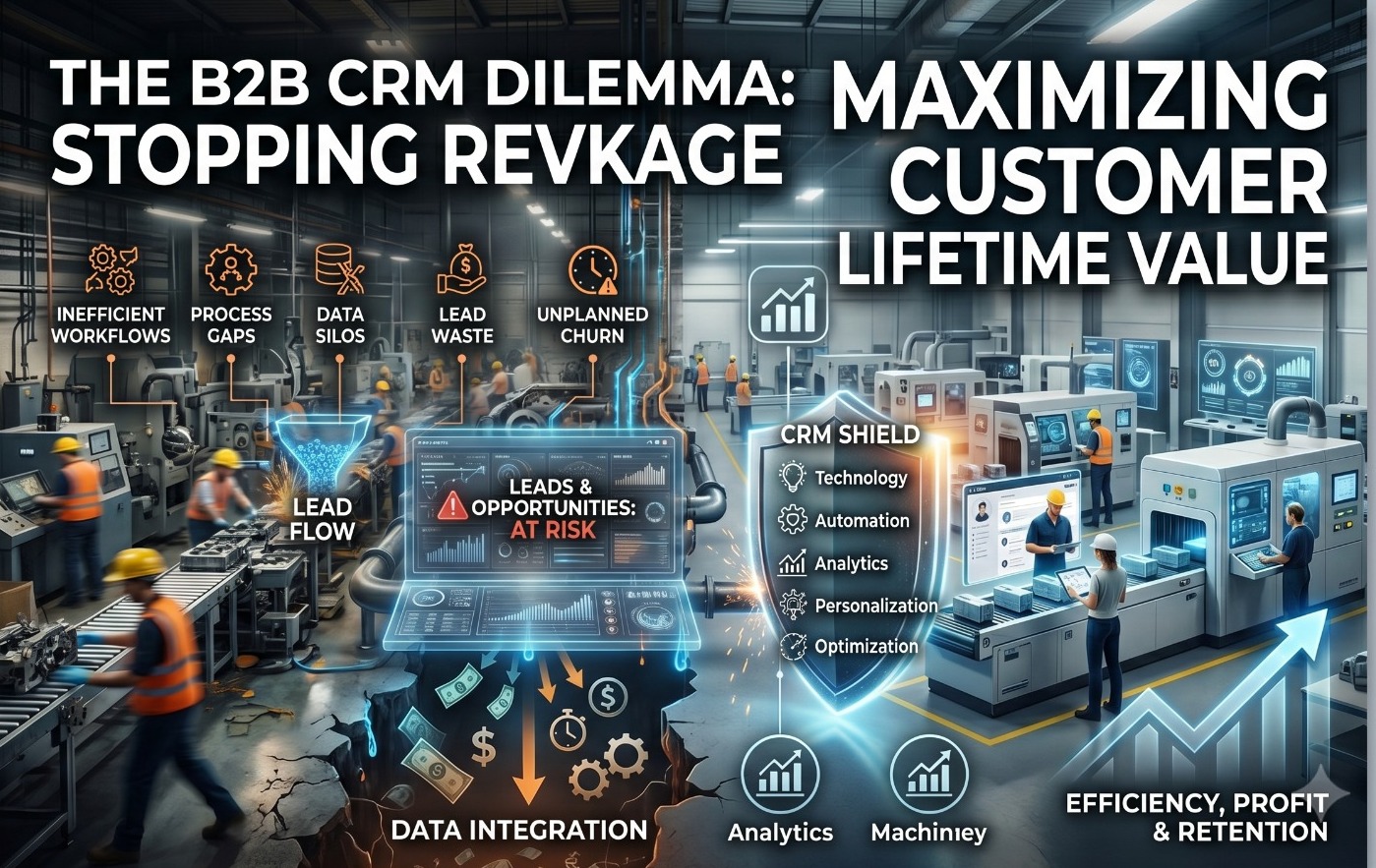
Your sales numbers look decent. Your team is busy. Yet somehow, at the end of every quarter, the profit just isn't there. Sound familiar? You're not imagining it — and you're definitely not alone.
Manufacturers and B2B businesses across the world are facing the same silent killer: money slipping away between what they should earn and what actually lands in their pocket. Business failure rarely comes from one catastrophic event. It comes from dozens of small inefficiencies compounding quietly across every stage of your operation.
If your sales are growing but your profits are shrinking, your business has a leakage problem — not a sales problem. Fixing leakage doesn't require more leads or bigger deals. It requires fixing what you're already losing.
What Is Operational Leakage?
The Silent Profit Drain
Operational leakage is the slow, invisible loss of money caused by wrong pricing, poor process control, and a careless approach to cost management. It's not a single moment of failure — it's a thousand small holes in the bucket.
In B2B and manufacturing environments, where supply chains and labour already strain margins thin, even a leakage of 1% to 2% can translate into staggering financial losses at scale. These seemingly minor inefficiencies compound over time and quietly hollow out a firm's economic viability.
- 1% leakage on ₹10 Cr annual revenue = ₹10 Lakh lost per year
- 2% leakage across 5 years = a year's worth of profit, gone
- Most businesses have 3–8% total leakage across their lifecycle
- The businesses that catch it early protect the most margin
Margin Leakage vs. Revenue Leakage
Two Different Problems, Two Different Fixes
These two issues are often confused — but they require entirely different diagnostic approaches. Understanding the difference is the first step to stopping both.
| Dimension | Margin Leakage | Revenue Leakage |
|---|---|---|
| Definition | Losing profit without realizing it | Losing income that should have arrived |
| Root Cause | Operational inefficiency & poor cost control | Sales/billing mistakes at the front end |
| Main Culprits | Poor cost handling, production inefficiencies, siloed departments | Wrong invoices, missed renewals, uncollected payments |
| Visible In | Shrinking gross & net profit margins | Declining sales income, high outstanding receivables |
| Severity | Medium–High | High–Critical |
Ignoring these leaks pushes businesses into the cost-cutting trap. To recover lost margins, budgets get slashed — which damages product quality, weakens client trust, and stops long-term growth dead in its tracks.
The 6 Stages Where B2B Businesses Lose Money
Profit Leaks Across the Entire Customer Lifecycle
Leakage doesn't happen in one place. It happens at every single stage of your customer journey — and most businesses are blind to at least half of it.
Stage 1: Lead Capture & Qualification
Slow, Incomplete, and Wasting Your Marketing Budget
The leakage starts before a single sales conversation even happens. When lead capture relies on simple forms with no automated data enrichment, your CRM fills up with incomplete and unreliable records.
- Without firmographic data — company size, industry, intent — valid leads go unrouted and ignored
- Marketing spend is wasted on leads that never get a qualified follow-up
- The absence of structured data makes the entire qualification process financially counterproductive
- Sales reps waste hours chasing dead-end leads while hot ones cool off
Stage 2: The Marketing-to-Sales Handoff
Warm Leads Going Cold in Hours
When there is no proper Service Level Agreement (SLA) governing the handoff between marketing and sales, warm leads go cold — sometimes within hours. Emails sent to the wrong person, too many alerts at once, unclear lead ownership: these are not minor process issues. They are direct profit destroyers.
- Respond within 24 hours of every marketing-qualified lead — no exceptions
- Route by territory, industry, or workload — not randomly or manually
- Auto-alert managers if a lead sits unattended past the SLA window
- Every lead has one clear owner recorded in the CRM from the moment it arrives
A pipeline health score isn't just about deal size. It's about velocity — how fast deals are actually moving.
Stage 3 & 4: Billing Errors & Quote-to-Cash Breakdowns
Leakage Continues Even After the Deal Is Closed
Most businesses assume the money is safe once a contract is signed. It isn't. Manual data entry errors produce wrong invoices. Missed contract renewals go unnoticed for months. Legal delays from billing disputes directly reduce cash flow — every week they remain unresolved.
- Manual re-entry errors between CRM, CPQ, and billing systems
- Discount drift — reps applying unauthorized discounts that never get caught
- Missed renewal dates causing automatic contract lapses
- Invoice disputes creating weeks of cash flow delay
- No automated audit trail connecting contract terms to active invoices
Stage 5: Onboarding & Early Churn
The Leaking Bucket Problem
When a newly acquired account undergoes a chaotic transition to the customer success team, the client's time-to-value is significantly delayed. They don't see results quickly. Dissatisfaction builds silently. And they cancel well before any renewal conversation can even happen.
- Milestone completion rate: Are project milestones being hit on time?
- Core feature adoption: Are users engaging with the key product features?
- Login frequency: Are users returning regularly, or dropping off?
- Support ticket volume: Is confusion causing friction in the early weeks?
A structured onboarding playbook — with clear step-by-step milestones, automated welcome sequences, and a combined health score — transforms early churn from a silent risk into a manageable metric.
Stage 6: Upsell & Expansion Blind Spots
The Easiest Revenue You're Not Collecting
Expansion revenue is the most capital-efficient growth available to any B2B company. Existing customers already trust you. The cost of acquiring them was paid months ago. Yet most B2B firms don't pursue cross-selling proactively — and the signals that a customer is ready to expand get missed entirely.
- Client usage reaching 80% of their current tier or seat capacity
- New departments under the same parent company creating accounts
- Support tickets and documentation searches for add-ons they haven't purchased yet
- Executive-level engagement increasing after a period of low activity
Proven Strategies to Stop Operational Leakage
Move From Manual Work to Automated, Accountable Processes
Fixing a leaking pipe permanently is fundamentally different from applying a temporary patch. The same principle applies to operational leakage. Here are the strategies that actually work — tested and validated across B2B and manufacturing environments.
A. Standardize and Enrich Lead Capture
- Enforce required fields and UTM tracking tags across all incoming channels
- Use AI-powered enrichment tools like ZoomInfo or Clearbit to fill missing firmographic data automatically
- Align Marketing and Sales on a single lead-scoring methodology to identify high-value buyers without delay
B. Enforce Strict Handoff SLAs
Set clear accountability rules directly inside your CRM. A lead that isn't followed up within the SLA window automatically triggers a manager alert — no exceptions, no manual oversight required.
C. Conduct Regular Pipeline Health Reviews
- Set CRM alerts for deals showing zero activity for 7–14 days
- Every deal must have one clear, mutually agreed next step before it advances
- Stop measuring pipeline by deal size alone — measure velocity and stage conversion rate
D. Automate the Entire Quote-to-Cash Process
Tightly integrating your CRM, CPQ software, contract management, and billing tools eliminates manual re-entry errors entirely. Add automated approval chains for custom contract redlines and run routine billing audits comparing active invoices against contracted terms to prevent discount drift.
E. Build a Structured Onboarding Playbook
One consistent, step-by-step onboarding journey with defined milestones ensures new users reach product value fast. Use automation to deliver welcome messages and feature guides at the exact moment users sign up — not days later when they've already disengaged.
F. Start Renewal Planning 90–120 Days Out
- 90–120 days out: Audit account health. Identify customers quietly considering leaving.
- 60–90 days out: Address friction points. Hold Executive Business Reviews.
- 30–60 days out: Present renewal terms clearly. Handle objections proactively.
- 0–30 days out: Close the contract and lock in billing before the window expires.
Waiting until the last 30 days to discuss renewal is one of the most common — and most expensive — mistakes in B2B. By then, the decision has usually already been made.
G. Build a Proactive Expansion Program
Train both Customer Success and Sales to act on clear signals. When client usage reaches 80% of their current tier, that's not something to note — it's something to act on immediately. Cross-functional coordination between CS and Sales on expansion opportunities is what separates companies with 110% net revenue retention from those stuck at 85%.
Pricing Control with CPQ
The Manufacturer's Most Powerful Leakage Tool
For manufacturers handling complex product configurations, an integrated Configure-Price-Quote (CPQ) platform is not a luxury — it's the difference between a controlled pricing process and financial chaos. An integrated CPQ puts strong guardrails on discounts so no representative can offer unauthorized pricing without triggering an approval chain.
Price Waterfall Analysis, run deal-by-deal, reveals exactly where margin is escaping — from list price all the way down to pocket margin. Every deduction point becomes visible: volume discounts, payment terms, freight allowances, promotional adjustances. Leadership gets full, real-time visibility on where the money is going.
Without CPQ, a 20% discount approved in one region becomes the expectation company-wide. With CPQ, every deviation is logged, approved, and measured — and margin leakage from pricing is eliminated at the source.
Find Out Where You're Losing Money
Our B2B Revenue Intelligence platform has helped 500+ manufacturers and B2B firms identify and close their biggest leakage gaps — fast.
Full Lifecycle Audit
We map every stage from lead to renewal and find the gaps
Pricing Waterfall Analysis
See exactly where margin is escaping on every deal
Pipeline Health Score
Velocity, stage conversion, and stagnation flags in one view
Fix Roadmap in 48 Hours
Prioritized, actionable steps — not a generic report
The Math: What Fixing Leakage Actually Returns
Real Numbers, Real Impact
- Annual revenue: ₹10 Crore
- Estimated total leakage: 5% = ₹50 Lakh lost per year
- Lead response rate: 40% (60% of leads never contacted)
- Contract renewal rate: 72% (28% churning annually)
- Net profit margin: 8%
- Annual revenue: ₹10 Crore (same)
- Leakage reduced to 1.5% = only ₹15 Lakh lost
- Lead response rate: 85% with automated SLA enforcement
- Contract renewal rate: 91% with structured 90-day playbook
- Net profit margin: 11.5% — a 43% improvement, same revenue
Every leak you find and fix is money going straight back into your pocket — without winning a single extra deal. The most efficient revenue growth available to any B2B business is recovering what it's already earning but losing.
Conclusion: Start With One Leak
Operational leakage is a battle lost inch by inch. One small pricing mistake or one missed renewal looks minor in isolation. But repeated across hundreds of B2B deals over months and years, it quietly destroys profit with no single moment of failure to point to.
The fix doesn't require a company-wide transformation overnight. Start by auditing your most vulnerable lifecycle phase. Establish clear cross-departmental accountability. Then implement automated tools — CRM enrichment, SLA enforcement, CPQ guardrails, onboarding health scores — to make revenue protection a continuous business practice rather than a quarterly crisis response.
The businesses winning in B2B and manufacturing aren't the ones with the biggest sales teams. They're the ones with the tightest systems — and the fewest leaks.