
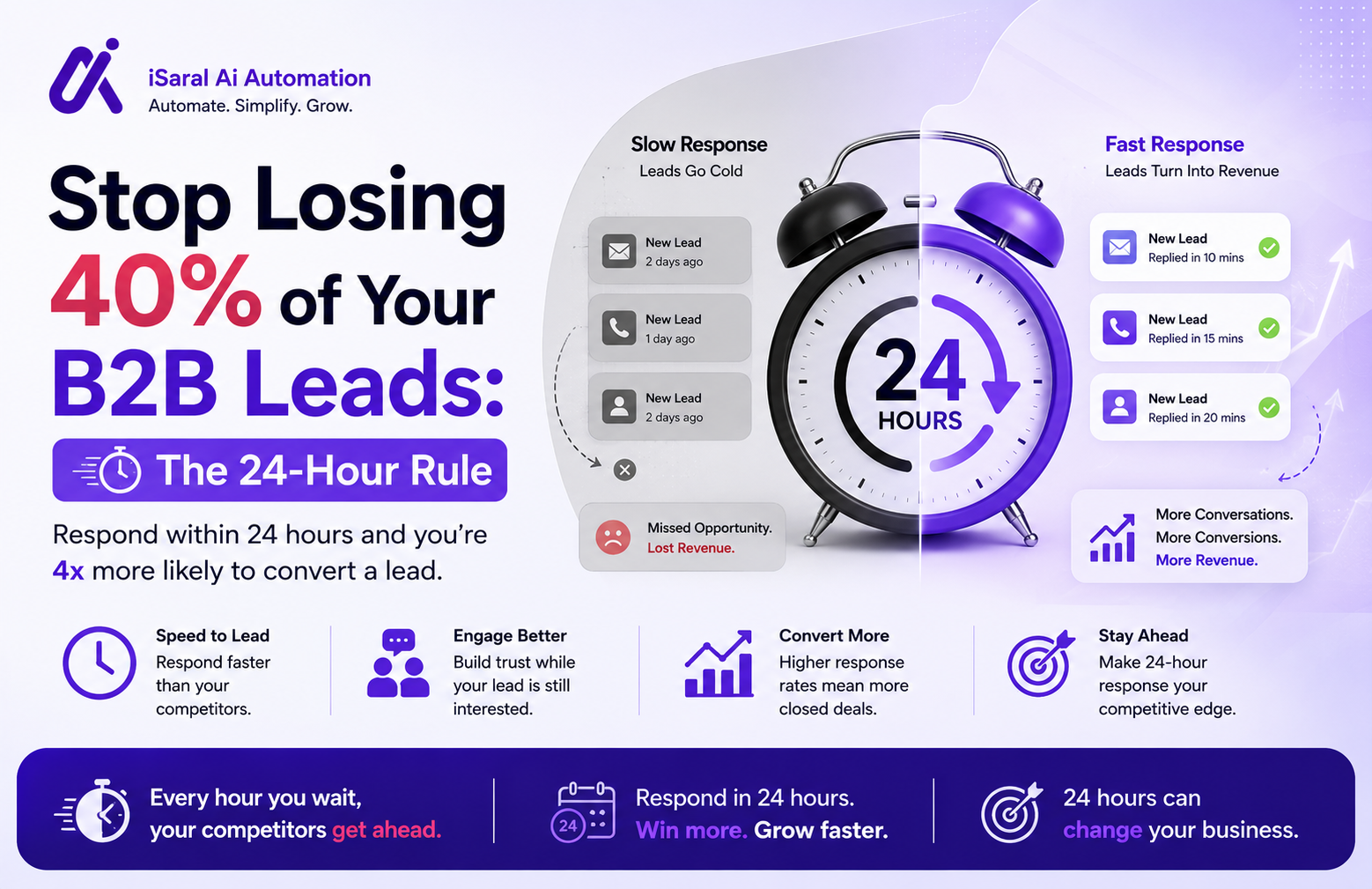
You're generating leads — maybe from Indiamart, maybe from Meta Ads, or perhaps a mix of both. But between the moment a lead lands and the moment your team makes contact, something goes wrong. Nearly 40% of prospects go cold, and you never hear from them again.
It's a painful reality for B2B sales teams and small business owners: you're spending good money on traffic, only to let half of it vanish because of slow follow-up. This guide will show you exactly why speed matters and how to fix it without burning out your team.
- Why the first 24 hours define your success — backed by actual data
- How different lead sources (Indiamart, Meta, Google) need different response strategies
- How to build auto-responses that don't feel robotic
- The three-touch rule that keeps leads warm without being pushy
- Measuring First Response Time instead of vanity metrics
Why the First 24 Hours Define Your Success
The Science Behind Speed
Research from the Harvard Business Review is crystal clear: responding within the first hour makes you 7x more likely to have a meaningful conversation with a decision-maker. Not 2x. Not 5x. Seven times.
After 24 hours, that window slams shut. Your prospect has either moved on to a competitor who picked up the phone, or they've mentally categorized you as "unreliable." When you wait too long, you aren't just losing a sale — you're losing the emotional momentum that made them take action in the first place.
Buyer intent is a perishable asset. The moment they reach out, they're actively considering a solution. Every hour you wait is an hour they spend talking to your competition instead.
The First Hour is Critical
If you respond within 60 minutes, you're competing on level ground. You're the vendor who actually cares. You get the conversation first, and you set the agenda.
Hours 2-12: You're Already Losing
Response rates drop dramatically after the first hour. Your prospect has already moved on to evaluating alternatives. You're now playing catch-up instead of leading.
After 24 Hours: It's Probably Too Late
At this point, most hot leads are already in conversations with someone else. A delayed response signals disorganization, lack of interest, or outdated processes.
The Hidden Cost of Ignoring Leads
What Slow Response Actually Communicates to Prospects
When a prospect reaches out and hears nothing, they don't assume you're busy. They make immediate assumptions about your organization:
- You're disorganized or don't use proper processes
- You're not interested in their business
- You're hard to work with or unreliable
- Your customer service will be just as slow after they buy
Speed of response is a trust signal. By the time you call on day two, your competitor is already two meetings deep with your lead. They've set expectations, started building rapport, and positioned their solution in the prospect's mind.
A 24-hour delay doesn't just hurt your chances — it actively signals to the prospect that they made the wrong choice reaching out to you in the first place.
Know Your Lead Source — They're Not All the Same
Different Sources Require Different Response Strategies
Not all leads are created equal, and treating them the same is a recipe for failure. The urgency, intent level, and communication style differ dramatically depending on where the lead came from.
Indiamart Leads
These prospects are "hot." They've searched, compared, and are likely talking to three of your competitors right now. They expect a professional, direct response within minutes — not hours.
Meta/Social Leads
These prospects were scrolling through reels when your ad caught their eye. Their intent is lower, and they need a softer, more nurturing touch before they're ready to talk business.
Google/Organic Leads
These prospects chose to find you through search. Their intent is higher, and they need value-driven information, not just a generic sales pitch. They've already done research.
Why This Matters
| Lead Source | Buyer Intent Level | Ideal Tone | Critical Window |
|---|---|---|---|
| Indiamart / B2B Marketplace | Very High | Direct, professional, solution-focused | 15-30 min |
| Google Organic / Search | High | Informative, consultative, knowledgeable | 2-6 hours |
| Meta / Social Ads | Medium | Soft, educational, relationship-building | 4-12 hours |
Building a Response System That Doesn't Feel Robotic
Automation That Actually Wins Trust
The goal of automation is not to replace humans — it's to buy your humans time to have real conversations. Your auto-responders need to feel personal, not mechanical.
The Art of the Personalized Auto-Responder
If your auto-reply says, "Thank you for your enquiry. We will get back to you shortly," you are actively hurting your brand. Generic messages tell the prospect you haven't read their specific request.
Instead, build an auto-responder that:
- Acknowledges their specific need — e.g., "Thanks for asking about our bulk steel pricing"
- Sets clear expectations — "Our team will reach out within 2 hours"
- Provides value immediately — Link to a brochure, case study, or relevant resource
- Shows you've listened — Reference something specific from their inquiry
Example: Good Auto-Response
"Hi [Name], thanks for reaching out about [specific product/service]. I can see you need [their stated requirement]. Our team will call you within 2 hours to discuss options. In the meantime, here's a quick resource that covers exactly what you asked about."
The Human Hand-Off
Automation gets the door open; your salesperson walks through it. The moment a prospect replies with a question, a real person should take over immediately. Stop the auto-replies the second a conversation starts.
Use automation for initial acknowledgment and value delivery (within minutes), but hand off to a human for any actual conversation. This gives you speed without sacrificing the personal touch that builds trust.
How to Write Replies That Actually Get a Response
The Follow-Up Formula That Works
Your first touchpoint shouldn't be a pitch — it should be a conversation starter. Keep it short, mention their specific inquiry, and ask one simple question.
Bad Approach (Generic)
"Thanks for reaching out. Please see our catalog attached."
Better Approach (Personal)
"Hi [Name], I saw you're looking for [Product]. We have stock ready. Would you like a price quote now, or would you prefer a quick call to discuss specs?"
The Three-Touch Rule for 24-Hour Follow-Up
Don't stop after one message. A structured follow-up sequence keeps leads warm without being pushy.
- 1 Touch 1 (Instant): A personalized message confirming receipt and setting expectations. This is your auto-responder but personalized to their specific inquiry.
- 2 Touch 2 (3–4 hours later): A value-add piece of content (brochure, case study, comparison guide). Remind them what you discussed in Touch 1.
- 3 Touch 3 (End of day): A brief, low-pressure check-in. "Just making sure you got the resource we sent over. Any questions?"
If they haven't replied after these three touches within 24 hours, they aren't ignoring you — they're just busy. Don't be pushy, but keep the door open for them to re-engage when they're ready.
Measuring the Only Metric That Matters: Speed
Stop Tracking Vanity Metrics
Most teams obsess over open rates, click rates, and reply rates — but miss the metric that actually drives revenue: First Response Time.
First Response Time: How long it takes from when a prospect reaches out to when your team responds. This single number correlates more closely with conversion rate and deal size than almost any other metric.
What You Should Actually Track
| Vanity Metric | What It Hides | Real Metric to Track |
|---|---|---|
| Email open rate | Doesn't predict replies or sales | First response time to incoming lead |
| Click-through rate | Clicks ≠ qualified interest | Leads contacted within 1 hour |
| Reply rate to outreach | Outbound replies are easier than speed on inbound | Average response time by lead source |
| Total leads generated | Volume without speed is waste | Leads responded to within 24 hours |
Your 30-Minute Weekly Audit
- Track daily: Know exactly how many leads came in and how many were contacted within target timeframes
- Audit weekly: Block 30 minutes every Friday to look for leads that slipped through the cracks
- Compare sources: Find out which channels (Indiamart vs. Meta) bleed the most leads and fix those workflows first
- Calculate cost per wasted lead: If you generate 100 leads at $5 cost each, and 40 go cold due to slow response, that's $200 in wasted spend per week
Lead Response Workflow Kit
Everything you need to implement the 24-hour rule — CRM setup guides, auto-responder templates, and response time tracking sheets sent to your inbox.
CRM Workflow Template
Automated routing rules for different lead sources
Auto-Responder Copy Bank
Ready-to-customize templates for each lead source
Three-Touch Follow-Up Sequences
Complete messaging sequences for your 24-hour window
Response Time Tracking Dashboard
Weekly audit checklist and metrics dashboard
Start Small, Move Fast
Your leads aren't dying because your product is bad or your ads are weak. They're dying because of the gap between interest and response. That gap is killing your conversion rates and wasting your marketing budget.
You don't need a massive team or enterprise-grade software to fix this. You need a system that ensures no inquiry sits in an inbox overnight. Start by automating your initial acknowledgment, setting up simple routing rules in your CRM, and enforcing a 30-minute response target for your sales team.
The leads are already coming in. Now make sure they don't go to waste. Implement the 24-hour rule, track First Response Time instead of vanity metrics, and watch your conversion rates climb — all while keeping your team sane.