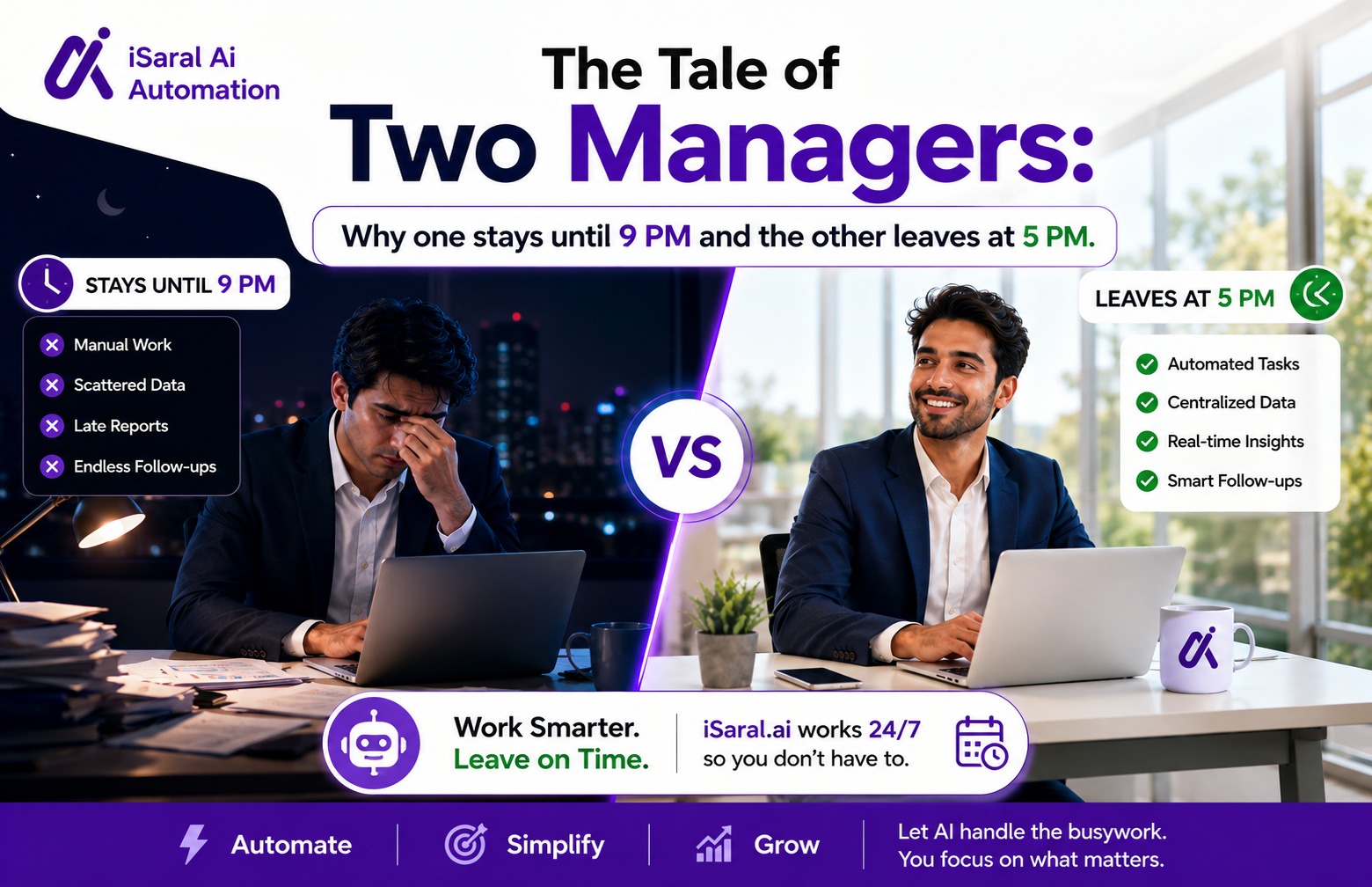
The contrasting habits of two managers — one leaving at five and the other staying until nine — reveal deeper differences in planning, delegation, and leadership. These patterns show how one manages time while the other is managed by it.
This guide is for managers, team leads, and founders who suspect their long hours are covering up a system problem rather than proving their commitment. What follows is a close look at two leadership styles, the habits that separate them, and the small shifts that move you from one to the other.
If your team can't function for a day without you fixing things, that isn't dedication — it's a structural gap in how work is organized. The fix starts with naming it honestly.
Profiles in Leadership: Alex, the 9 PM Manager
Busy Looks Like Commitment — But Isn't
It's 8:47 PM, and Alex is still at his desk, replying to emails and fixing reports his team didn't get right. He jumps into group chats to solve after-hours problems, leaving his tomorrow fully packed.
To outside observers, Alex seems dedicated. He is always in the middle of everything, doing busy work. However, his team has stopped trying to solve problems on their own because they know Alex will do it for them. He takes pride in his exhaustion, believing long hours prove his commitment.
Profiles in Leadership: Sarah, the 5 PM Manager
Calm Looks Like Doing Less — It Isn't
Sarah closes her laptop at 4:55 PM and leaves on time. She isn't rushing or taking shortcuts; her team works smoothly, deadlines are met, and her phone stays silent after hours.
Sarah spends her mornings assessing priorities and engaging with her team, ensuring they have the resources to handle challenges before they arise. Her focused approach ensures no urgent tasks spill over, allowing her to clear all pending matters within the workday.
Alex
The 9 PM ManagerFixes everything himself. Team waits for him to step in. Pride built on visible exhaustion.
Sarah
The 5 PM ManagerPlans mornings around priorities. Team solves problems independently. Pride built on results.
The True Cost of Long Hours
Why "Working Harder" Often Means "Managing Worse"
Long hours are often a sign of poor leadership rather than hard work. While Alex might look like he cares more, his habits create a bottleneck. Sarah has built a system where she doesn't need to fix everything.
One manager is required to keep the work going, while the other ensures the work continues on its own — that distinction is the entire difference between the two styles.
| Signal | Alex (9 PM Manager) | Sarah (5 PM Manager) |
|---|---|---|
| Where the day is spent | Reacting to problems as they surface | Assessing priorities each morning |
| Team's problem-solving | Waits for the manager to step in | Solves issues independently |
| After-hours availability | Always reachable, always pulled in | Phone stays silent after work |
| Source of pride | Visible exhaustion | Consistent, on-time outcomes |
Strategies for Effective Management: Prioritization and Systems
Not All Work Deserves Equal Time
A good manager knows not to give equal time to all work. They identify high-impact tasks and tackle them during fresh morning hours. Low-value requests are handled through batching or delegation, and reactive work is confined to fixed time blocks.
- High-impact tasks get the best hours of the day, not the leftover ones
- Low-value requests are batched or delegated instead of handled one at a time
- Reactive work is confined to fixed time blocks, not left to interrupt everything else
- Playbooks and checklists let routine tasks run on autopilot
Repeating the same answer twice is a system failure. Effective managers develop playbooks and checklists so routine tasks run on autopilot, freeing the team for work that requires human thinking.
Strategies for Effective Management: Coaching and Delegation
Stop Being the Only Source of Answers
Managers who act as the sole source of answers fall into a time trap. The 5 PM manager coaches the team to make independent decisions, asking, "What would you do?" rather than providing every solution.
This builds a team that functions without constant supervision and sets clear limits on when they can act on their own. Every question answered with "what would you do?" instead of a direct fix is a small deposit toward a team that no longer needs you in the room.
Strategies for Effective Management: Measuring Success by Outcomes
Hours Logged Are Not the Same as Value Delivered
Value lies in outcomes, not hours logged. Success should be measured by meeting targets, stakeholder satisfaction, and how quickly the team solves problems.
When a team delivers quality work on time, exact working hours become irrelevant. Reputation is built on results, not on showing how much you suffer.
Become the Manager Who Leaves at Five
Get the practical framework for prioritization, delegation, and outcome-based reviews — sent straight to your inbox.
Delegation Decision Tree
Know in seconds what to hand off versus what to keep
Weekly Prioritization Template
Plan mornings around what actually moves the needle
"What Would You Do?" Script
Coaching questions that build independent decision-makers
Outcome-Based Scorecard
Track results instead of hours logged at a desk
The Shift in Mindset
From Carrying Every Burden to Building a System
The distinction between these managers is how they view their role. One carries every burden alone, while the other builds a capable system.
Changing from a 9 PM manager to a 5 PM manager starts with small steps: delegating one task, blocking time on the calendar, and recognizing that true skill is making sure the work runs smoothly even when you aren't there.
The Bottom Line: Build a System, Not a Bottleneck
Long hours don't prove commitment — they often reveal a system that depends entirely on one person. Alex's exhaustion looks like dedication from the outside, but it has trained his team to stop solving problems on their own.
Sarah's calm isn't the absence of effort — it's effort spent earlier, on prioritization, coaching, and clear systems that let the work continue without her in the room.
You don't have to overhaul everything at once. Delegate one task this week, block one hour for morning priorities, and ask "what would you do?" the next time someone brings you a problem — the shift from 9 PM to 5 PM starts there.