
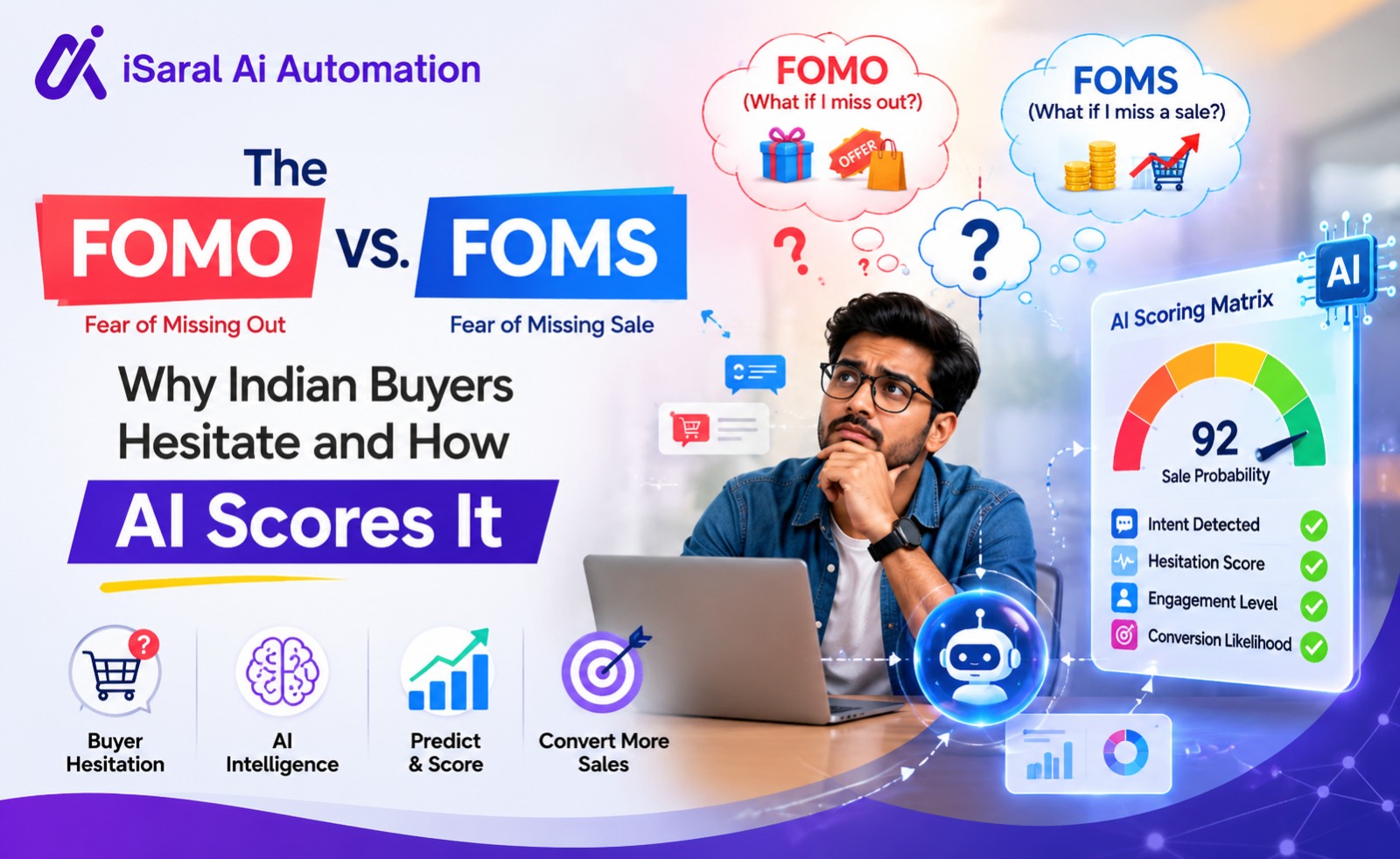
You've seen it happen on your own analytics dashboard. A shopper browses a product for twenty minutes, reads every review, adds the item to their cart — and then disappears. No purchase. No abandoned-cart email reply. Nothing.
For Indian buyers especially, that silence isn't apathy. It's a quiet negotiation happening entirely in their head, between two opposing instincts: the urge to buy now before the product or moment slips away, and the urge to wait because a better price might be one festival sale away.
This guide unpacks both forces, why they hit harder in the Indian market than almost anywhere else, and how AI-driven hesitation scoring helps brands respond to that internal tug-of-war instead of just discounting blindly.
High-intent traffic, full carts, and stalled checkouts aren't a targeting problem or a pricing problem on their own. They're a signal that the buyer is stuck between two fears — and your funnel probably has no way to tell which one is winning.
Defining FOMO and FOMS in the Indian Buyer's Mind
FOMO: The Fear of Missing Out
When a limited-edition sneaker or a trending gadget floods your social feed, the restless urgency you feel is FOMO. It's the instinct that says act now, buy before it's gone, prioritize belonging over budget. It's what turns a casual scroller into an impulsive buyer in under sixty seconds.
FOMS: The Fear of Missing a Sale
FOMS is the quieter, more calculating cousin. It whispers: what if a better deal drops tomorrow? It's the instinct to wait, compare, and protect against buyer's remorse by holding out for the right price point — even when the product is already sitting in the cart.
| Force | Trigger | Resulting Behavior |
|---|---|---|
| FOMO | Trend urgency, social proof, scarcity | Impulsive, fast purchase |
| FOMS | Deal anticipation, festival sale memory | Delay, comparison shopping, cart abandonment |
Every stalled cart is a buyer caught between two fears, not a buyer who stopped caring. The question isn't "why didn't they buy" — it's "which fear is currently winning."
Together, these opposing forces create genuine decision paralysis. The buyer wants the product and wants the deal, and until one fear outweighs the other, the cart just sits there.
FOMO Profile — The Trend Chaser
Driven by Belonging, Not Budget
A FOMO-dominant buyer is reacting to social momentum. They've seen the product trending, seen peers buying it, and feel the clock ticking on relevance rather than on price. Speak to this buyer in discount language and you'll bore them. Speak to urgency and scarcity, and you'll move them.
| Signal | What It Looks Like |
|---|---|
| Browsing Pattern | Fast session, low number of price-comparison tabs |
| Trigger Content | Social proof, "trending now," limited stock badges |
| Best Nudge | "Only a few left" alerts, peer adoption counters |
| Risk if Mishandled | Fake urgency erodes trust fast with this segment too |
FOMS Profile — The Deal Hunter
Driven by Value, Not Velocity
A FOMS-dominant buyer is doing math in the background — comparing your price against memory of last year's sale, against a competitor's listing, against the nagging sense that patience usually pays off in Indian e-commerce. Rushing this buyer with a countdown timer often backfires; they've learned to wait out fake urgency.
| Signal | What It Looks Like |
|---|---|
| Browsing Pattern | Multiple sessions, price-tracking, tab-switching to compare |
| Trigger Content | Price-drop history, savings calculators, cashback windows |
| Best Nudge | Time-bound cashback, transparent "best price" assurance |
| Risk if Mishandled | Generic discounts feel like a trap, not a deal |
Most buyers aren't purely one or the other — they sit somewhere on a spectrum between FOMO and FOMS. The goal of AI scoring isn't to label someone permanently; it's to read which fear is dominant right now, in this session, and respond to that.
Why Indian Buyers Hesitate at the Point of Purchase
Hesitation in the Indian market isn't a UX failure on your part — it's a learned behavior, shaped by years of festival discounting, family-led purchase decisions, and a well-earned skepticism about online pricing.
Price Sensitivity and the Expectation of Discounts
Purchases are rarely impulsive top-to-bottom. Many buyers pause expecting a better price to appear, treating full-price as a starting offer rather than a final one.
Peer Influence and Social Validation
Before finalizing, buyers often check in with family, friends, or online communities. That validation acts as a safety net that reduces the perceived risk of the purchase.
Distrust of Online Pricing
A nagging question lingers: is this really the best price, or is someone else paying less for the same thing? That doubt alone is enough to stall a checkout.
Festival Sale Conditioning
Diwali, Big Billion Days, and similar events have trained buyers to strategically postpone non-urgent purchases until those windows open.
Festival Sale Cycles and the Timing of Hesitation
If you sell in India, your conversion funnel is competing with a calendar. Big Billion Days, Diwali, end-of-season sales — these aren't just promotional events, they're trained reflexes. A buyer who has saved money by waiting once is statistically far more likely to wait again.
Brands that ignore this rhythm end up fighting the calendar with generic urgency banners. Brands that plan around it — pre-festival teaser pricing, post-festival loyalty nudges, off-cycle exclusivity drops — convert the same hesitant buyer without devaluing the brand.
Step 1: Score the Buyer Before You Message Them
Every effective FOMO-FOMS strategy starts with reading the buyer correctly, not guessing. AI hesitation scoring looks at session behavior — dwell time, comparison-tab switching, return visits, scroll depth on pricing sections — and translates it into a live score on the FOMO-FOMS spectrum.
- How many times has this buyer returned to the same product page?
- Are they comparing prices across tabs or marketplaces?
- Did they arrive from a trending/social link or a price-comparison search?
- Have they previously responded to urgency cues or only to discount cues?
| Buyer Signal | Likely Profile | AI-Driven Response |
|---|---|---|
| Single fast session, social referral | FOMO-dominant | Scarcity badge, peer-adoption counter |
| Multiple sessions, price-tab switching | FOMS-dominant | Time-bound cashback, price-match assurance |
| Cart added, no return visit yet | Undetermined / early stage | Soft reminder, no aggressive discount yet |
| Repeated visits across festival windows | Strong FOMS, sale-trained | Pre-festival exclusive access offer |
| High scroll on reviews, low on price | Leaning FOMO, trust-seeking | Social proof + limited-stock framing |
Step 2: Match the Message to the Dominant Fear
Once a buyer is scored, the messaging strategy should reflect whichever fear is currently winning — not a one-size-fits-all banner. The same product, the same buyer even, may need entirely different copy depending on which side of the matrix they're sitting on this week.
Urgency cues only work when they're credible. Countdown timers and "almost sold out" banners that don't reflect real inventory get noticed fast by India's increasingly savvy digital shoppers — and once trust breaks, both FOMO and FOMS buyers disengage for good.
Step 3: Measure Conversion Uplift, Not Just Clicks
Scoring buyers and tailoring messages is only half the job. The real test is whether matrix-based personalization actually moves the numbers that matter — and whether it holds up over multiple purchase cycles, not just one festival sale.
Track Segment-Level Conversion
Compare conversion rates for FOMO-dominant and FOMS-dominant cohorts before and after matrix-based personalization goes live.
Monitor Drop-Off Points
Map exactly where hesitation spikes in the funnel — product page, cart, or payment step — for each profile separately.
Compare Average Order Value
Check whether FOMO and FOMS cohorts respond differently in basket size after intervention, not just in conversion rate.
Watch Repeat Purchase Rates
Trust-based nudges should improve loyalty over time. If repeat rates dip, your urgency cues may be working short-term at the cost of long-term trust.
A buyer correctly read once becomes easier to read every time after. As the scoring model accumulates session history across festival cycles, repeat visits, and past responses to offers, the matrix gets sharper — turning a one-time campaign tactic into a permanent, self-improving conversion layer.
Stop Guessing Why Carts Go Cold
See how AI-driven FOMO-FOMS scoring works on your own product pages — book a free walkthrough with our team this week.
Live Hesitation Scoring Demo
See real session signals turned into a FOMO-FOMS score in real time
Ready-to-Use Nudge Templates
Copy-paste messaging for both buyer profiles — no rebuilding from scratch
Festival Cycle Timing Map
Know exactly when your buyers expect a sale — and when they don't
Cart Recovery Playbook PDF
The full framework from this article, formatted for your team
The Bottom Line
The tug-of-war between FOMO and FOMS sits at the heart of nearly every Indian buyer's decision-making journey. Whether someone is rushing to grab a deal before it disappears, or holding back because they believe a better price is one festival away, where they sit on this matrix is the key to unlocking the purchase.
You now know why Indian buyers hesitate, what's driving that hesitation psychologically, and how AI can score and respond to it with precision instead of blanket discounting.
The advantage belongs to whoever uses this first. Start scoring your buyers today, let AI do the reading, and turn hesitation into a conversion lever instead of a mystery.