
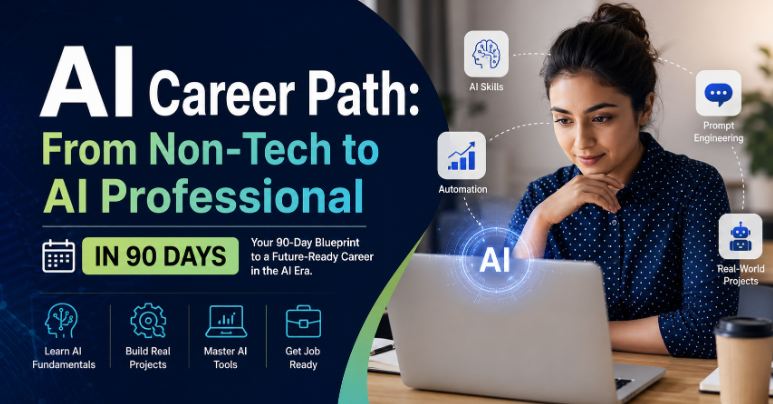
Artificial Intelligence is no longer limited to software engineers and data scientists. Today, following a dedicated AI Career Path allows professionals from sales, marketing, HR, finance, customer support, operations, and even fresh graduates to successfully transition into high-paying, AI-powered careers.
The biggest misconception is that you need a computer science degree or years of coding experience to enter the AI industry. The reality is very different. With the right learning strategy, practical projects, and hands-on experience, anyone can become job-ready in the AI and automation era. This guide provides a practical 90-day roadmap specifically designed for non-technical individuals who want to learn AI, build real-world projects, and prepare for high-demand AI careers.
1. Why AI Skills Are Essential in 2026
Artificial Intelligence is transforming every industry. Businesses are actively seeking professionals who can automate repetitive tasks, improve productivity using AI tools, build AI-powered workflows, create intelligent customer experiences, analyze data and generate actionable insights, and implement AI solutions without extensive coding.
Industry trends show increasing demand for AI-skilled professionals across:
- Marketing
- Operations
- Healthcare
- Education
- Customer service
- Finance
The opportunity is no longer limited to developers. Companies need professionals who understand business challenges and can use AI to solve real-world problems.
2. Understanding the Modern AI Career Landscape
High-Demand AI Jobs for Non-Technical Professionals
Before starting your journey, it's important to understand the career opportunities available in today's AI-driven market. Many of these roles require strong problem-solving and business skills rather than advanced programming knowledge.
⚙️ AI Automation Specialist
- Designs and implements automated workflows using AI tools to improve business efficiency.
✍️ AI Prompt Engineer
- Creates structured prompts that maximize AI performance and improve productivity.
🧩 AI Operations Consultant
- Helps businesses integrate AI into daily operations and streamline processes.
📈 AI Marketing Specialist
- Uses AI for content generation, lead nurturing, personalization, and campaign optimization.
📊 AI Business Analyst
- Identifies opportunities where AI can increase efficiency, reduce costs, and improve outcomes.
🤝 AI Customer Success Manager
- Implements AI-powered customer support systems and engagement strategies.
3. The Ultimate 90-Day AI Career Path
This structured AI Career Path is divided into three distinct phases that gradually build your knowledge, skills, and job readiness.
Build Your AI Foundation
Days 1–30The first month of your AI Career Path focuses on understanding fundamental AI concepts and becoming deeply comfortable with modern AI tools.
Start by understanding what AI is, Machine Learning basics, Generative AI concepts, Large Language Models (LLMs), AI automation workflows, and ethical AI practices. At this stage, focus on how AI solves business problems rather than getting overwhelmed by technical terminology.
Become highly familiar with the core tools driving the industry: ChatGPT, Claude, Gemini, Perplexity, Midjourney, Canva AI, and Notion AI. Spend at least one hour daily experimenting with prompts, workflows, and practical use cases.
Prompt engineering is one of the fastest ways to build AI expertise. Learn how to write structured prompts, generate better AI outputs, create role-based prompts, build reusable prompt libraries, and optimize AI responses.
Learn AI Automation and Build Projects
Days 31–60The second month of your AI Career Path shifts the focus toward practical implementation, system integrations, and hands-on learning.
Study common business processes that are ripe for disruption — lead management, customer support, appointment scheduling, content creation, email marketing, and sales follow-ups. Identify repetitive tasks that AI can automate efficiently.
Modern automation tools allow anyone to create powerful workflows without writing a single line of code — Make, Zapier, n8n, Pabbly Connect, Airtable, and Google Sheets Automation. Focus on connecting multiple tools together into cohesive, automated systems.
Practical projects transform theoretical knowledge into real-world expertise. To stand out on your AI Career Path, try building these four core projects:
AI Lead Qualification System
Automatically capture incoming leads from web forms, analyze their intent using an LLM, and prioritize prospects in a Google Sheet or CRM.
AI Content Generator
Create an automated engine that takes a single topic input and generates blogs, social posts, email campaigns, and marketing content tailored to a brand voice.
AI Customer Support Assistant
Build a custom chatbot trained on a company's FAQ document, capable of handling customer inquiries and routing complex issues to humans.
AI Email Automation Workflow
Create personalized, contextual email responses to customer inquiries using AI-powered sentiment analysis and automation platforms.
Become Job-Ready
Days 61–90The final phase of your AI Career Path focuses on building market credibility, packaging your skills, and preparing for career opportunities.
Employers care more about practical skills than certificates alone. Your portfolio should include AI automation projects, workflow screenshots, project documentation, business use cases, and measurable results (e.g., "Reduced response time by 40%"). A strong portfolio demonstrates your ability to apply AI in real-world scenarios.
Update your LinkedIn profile, resume, personal website, and GitHub profile (optional). Highlight your AI projects, certifications, automation workflows, and achievements. Include relevant keywords so recruiters can discover your profile easily: AI Automation, Prompt Engineering, Generative AI, Workflow Automation, AI Solutions, and AI Career Path.
Practice answering questions such as: How have you used AI to solve a specific business problem? Which AI tools are you most proficient with, and why? Can you explain the logic behind an automation workflow you built? How do you evaluate and minimize inaccuracies in AI-generated outputs? Employers increasingly prioritize practical demonstrations and live portfolio walkthroughs over theoretical knowledge.
4. Essential Skills & Common Mistakes
Essential Skills for a Successful AI Career Path
To succeed in this rapidly growing landscape, focus on developing a balanced skill set that blends technical execution with business strategy.
| Technical Skills | Business Skills | Human-Centric Skills |
|---|---|---|
| Prompt Engineering | Problem Solving | Creativity |
| AI Tool Utilization | Communication | Adaptability |
| Workflow Automation | Project Management | Collaboration |
| Data Analysis Fundamentals | Critical Thinking | Strategic Thinking |
| AI Content Creation | Decision Making | Continuous Learning |
The combination of technical, business, and human skills creates highly valuable AI professionals who can bridge the gap between technology and revenue.
Common Mistakes to Avoid on Your AI Career Path
Master a few powerful tools deeply (like Claude, Make, and Airtable) rather than exploring dozens superficially.
AI is a practical field. Build projects from the very beginning.
Perfectionism delays progress. Start building, break things, and improve continuously.
Companies hire professionals who solve business problems, not those who only understand AI terminology.
Career Opportunities After Following This AI Career Path
After 90 days of focused learning and project-building, you can position yourself for high-growth roles such as:
As businesses continue investing heavily in AI and automation, demand for these positions is expected to grow significantly throughout the decade.
Why Choose Us?
Get full access to premium features for 7 days, completely free.
Full Access
Access all premium features without any restrictions
No Credit Card
Start instantly without providing payment details
Expert Support
Our dedicated team is always here to help you succeed
Cancel Anytime
No hidden charges or long-term commitments required
Conclusion: Start Your 90 Days Today
The rise of Artificial Intelligence is creating one of the biggest career opportunities of this generation. You do not need a technical background, advanced coding skills, or years of experience to participate in this transformation.
By following this structured AI Career Path, dedicating 90 days to focused learning, building practical projects, and developing real-world problem-solving abilities, you can successfully transition from a non-technical professional to a highly competitive, AI-ready candidate.
The future belongs to professionals who can combine human creativity with AI-powered productivity. Start today, stay consistent, and position yourself for success in the rapidly evolving AI economy.