
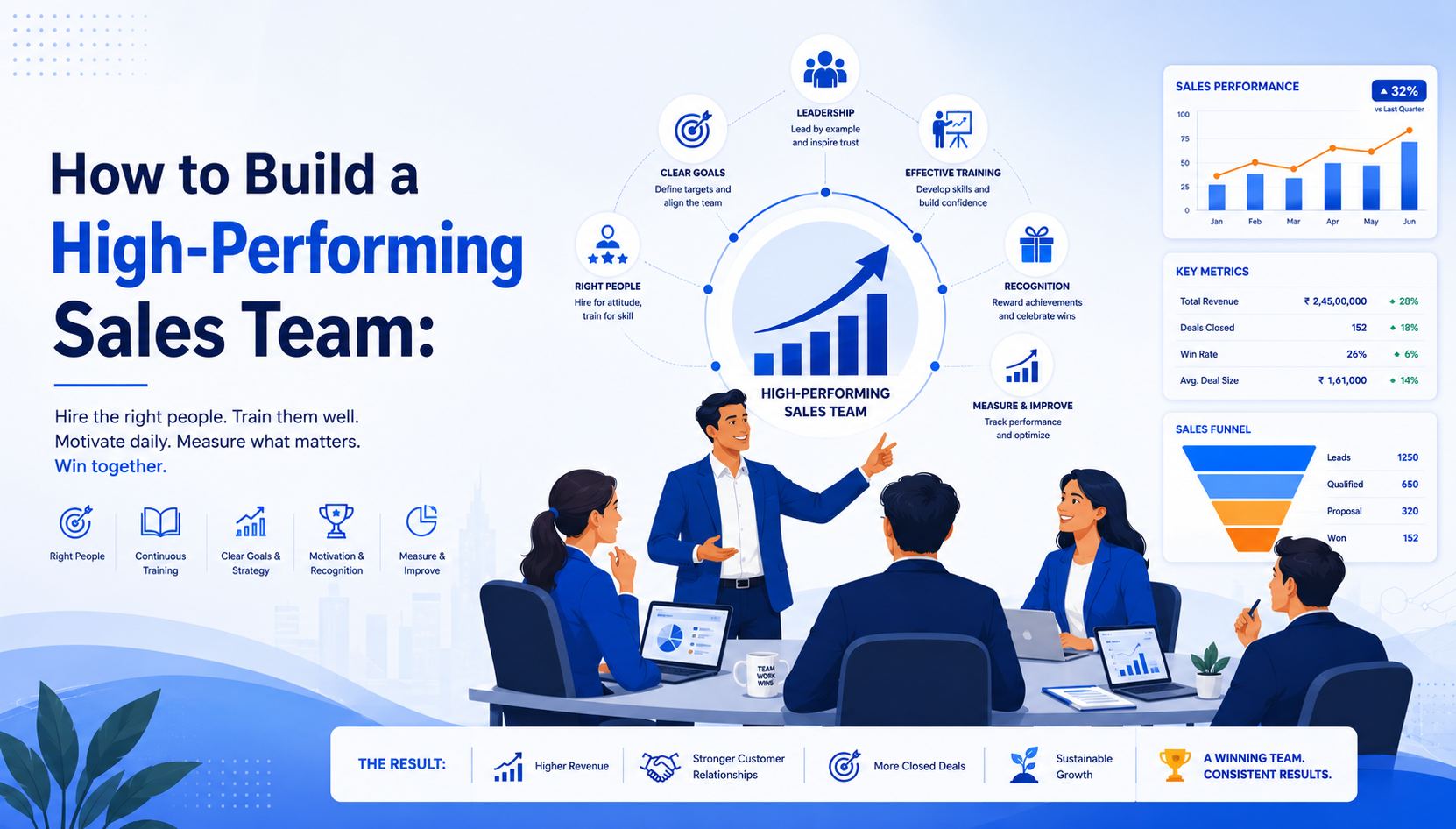
How to Build a High-Performing Sales Team: 15 Proven Strategies for Business Growth (2026 Guide)
A high-performing sales team is one of the most valuable assets any business can have. Regardless of whether you're a startup, a small business, or an established enterprise, your sales team directly influences revenue, customer satisfaction, and long-term growth.
However, creating a successful sales team isn't simply about hiring talented salespeople. It requires a combination of strategic recruitment, effective leadership, continuous training, the right technology, and a culture that encourages learning and accountability.
Businesses with well-structured sales teams consistently outperform competitors because they follow defined processes, use data to improve performance, and focus on building strong customer relationships instead of simply closing deals.
In this comprehensive guide, we'll explore 15 proven strategies for building a sales team that consistently achieves targets and contributes to sustainable business growth.
What Is a High-Performing Sales Team?
A high-performing sales team is a group of professionals who consistently achieve or exceed their sales goals while maintaining excellent customer relationships.
- Clear, measurable goals
- Well-defined sales processes
- Strong leadership and direction
- Continuous coaching and development
- Effective internal communication
- Data-driven decision-making
- Customer-focused selling approach
- Collaborative team environment
Why Building the Right Sales Team Matters
Your products and services may be excellent, but without a capable sales team, reaching customers becomes challenging. An effective sales team helps businesses achieve multiple critical objectives:
- Increase revenue directly
- Accelerate sales cycles
- Close larger deals
- Improve profit margins
- Create predictable growth
- Generate qualified leads
- Build customer trust
- Improve retention rates
- Strengthen brand reputation
- Identify new opportunities
Investing in your sales team is one of the most effective ways to improve overall business performance and create competitive advantage.
15 Proven Strategies to Build a High-Performing Sales Team
Below are 15 essential strategies that successful organisations implement to build and maintain high-performing sales teams:
Building a successful sales team begins with recruitment. Rather than focusing only on previous sales experience, look for candidates who possess critical qualities:
- Excellent communication skills
- Confidence and self-belief
- Problem-solving ability
- Emotional intelligence
- Adaptability to change
- Strong work ethic
- Positive, coachable attitude
- Willingness to learn continuously
Confusion about responsibilities often leads to poor performance and missed opportunities. Each salesperson should understand exactly what they're responsible for.
| Sales Role | Primary Responsibilities |
|---|---|
| Sales Development Rep (SDR) | Generate and qualify leads, initial outreach |
| Account Executive | Handle demos, negotiations, close deals |
| Account Manager | Maintain relationships, identify upsell opportunities |
| Sales Manager | Lead team, coach reps, monitor performance, strategy |
Clearly defined roles improve accountability, reduce overlap, and enable team members to specialise and excel in their areas.
Top-performing businesses rarely rely on improvisation. Instead, they establish a repeatable sales process that every team member follows consistently.
- Prospecting
- Lead qualification
- Initial contact
- Needs analysis
- Product presentation
- Objection handling
- Proposal submission
- Negotiation
- Closing
- Post-sale follow-up
- Ensures consistency
- Improves forecasting
- Easier to train
- Identifies bottlenecks
- Reduces errors
- Accelerates onboarding
- Measurable results
- Better management
Sales techniques, customer expectations, and market conditions evolve constantly. Continuous training keeps your team competitive and confident.
Goals provide direction and motivation. The SMART framework ensures goals are meaningful and achievable:
- Specific — Clear, well-defined target
- Measurable — Quantifiable progress tracking
- Achievable — Realistic and attainable
- Relevant — Aligned with business strategy
- Time-bound — Clear deadline
Customer Relationship Management (CRM) software is essential for managing customer interactions and tracking sales activities. When used consistently, a CRM:
- Stores and organises customer information
- Tracks complete communication history
- Manages sales opportunities
- Automates follow-up tasks
- Forecasts revenue accurately
- Generates performance reports
- Improves team collaboration
- Prevents customer oversight
Culture significantly influences team performance and employee retention. A positive sales culture encourages:
- Collaboration is valued
- Respect is mutual
- Knowledge is shared
- Innovation is encouraged
- Accountability is clear
- Celebrate team wins
- Encourage learning
- Support growth
- Recognise efforts
- Lead by example
Modern buyers expect personalised solutions rather than aggressive sales tactics. Encourage your sales team to adopt consultative selling:
- Listen actively to customer challenges
- Ask thoughtful, probing questions
- Understand the full business context
- Recommend appropriate, honest solutions
- Provide genuine value, not just price
Monitoring performance helps identify strengths and areas for improvement. Track these important metrics:
| Metric | What It Measures |
|---|---|
| Revenue Generated | Total sales value closed |
| Qualified Leads | Number of viable prospects |
| Conversion Rate | % of leads that become customers |
| Average Deal Size | Mean value per transaction |
| Customer Acquisition Cost | Cost to acquire one customer |
| Sales Cycle Length | Time from lead to close |
| Win Rate | % of proposals converted |
| Customer Retention | % of customers retained |
Successful sales managers act as coaches rather than supervisors. Effective coaching includes:
- Regular one-to-one meetings
- Constructive, actionable feedback
- Skill development and training
- Formal performance reviews
- Goal setting and tracking
- Mentoring and guidance
- Recognition of achievements
Sales should not operate in isolation. Encourage collaboration between:
- Marketing teams
- Customer support
- Finance department
- Product development
- Peer mentoring
- Best practice sharing
- Team knowledge base
- Win/loss analysis
Recognition motivates employees to maintain high standards and continue delivering results. Rewards may include:
- Performance bonuses tied to results
- Commission incentives and accelerators
- Public recognition programmes
- Career advancement opportunities
- Additional training and development
- Flexible working arrangements
- Executive perks and travel
Modern sales teams rely on analytics and data rather than assumptions. Analyse data such as:
- Sales trends over time
- Customer behaviour patterns
- Product performance by segment
- Lead source effectiveness
- Marketing campaign results
- Customer lifetime value
- Win/loss analysis
- Team performance benchmarks
A successful sales team requires effective leadership. Strong sales leaders:
- Inspire confidence in their team
- Communicate clearly and consistently
- Set realistic, challenging expectations
- Support team members actively
- Resolve conflicts constructively
- Make informed, timely decisions
- Lead by example
- Take accountability for results
Learning should be part of everyday sales activities. Encourage employees to:
- Attend industry events and conferences
- Read sales books and articles
- Complete online courses and certifications
- Participate in webinars and workshops
- Share best practices with peers
- Learn directly from customer feedback
- Stay updated on market trends
Common Mistakes to Avoid
Many organisations struggle with sales performance because they make avoidable mistakes:
- ✕Hiring Based Solely on Experience — Overlooking attitude and coachability
- ✕Providing Insufficient Training — Expecting new hires to perform immediately
- ✕Setting Unrealistic Targets — Demoralising teams with impossible goals
- ✕Ignoring Customer Feedback — Missing opportunities for improvement
- ✕Failing to Use CRM Consistently — Losing valuable data and insights
- ✕Micromanaging Employees — Reducing autonomy and motivation
- ✕Poor Communication — Creating confusion and misalignment
- ✕Lack of Performance Reviews — Missing opportunities for coaching
Best Practices for Building a Successful Sales Team
To create a high-performing sales organisation, follow these best practices:
- ✓Hire Individuals with Strong Learning Ability — Look beyond experience to potential
- ✓Establish Structured Onboarding — Set new hires up for success from day one
- ✓Standardise the Sales Process — Ensure consistency across all reps
- ✓Invest in Regular Training — Keep skills sharp and current
- ✓Use CRM Software Consistently — Maintain accurate records and data
- ✓Monitor Performance Metrics — Measure what matters
- ✓Provide Regular Coaching — Support continuous improvement
- ✓Celebrate Wins and Learn from Losses — Build positive team culture
- ✓Focus on Customer Relationships — Long-term value over quick sales
- ✓Review and Refine Strategies — Continuously evolve and improve
Conclusion
Building a high-performing sales team is an ongoing process, not a one-time project. It requires thoughtful hiring practices, effective leadership, continuous training, clear goals, and a customer-first mindset that prioritises relationships over quick sales.
Organisations that invest in developing their sales teams create stronger customer relationships, improve operational efficiency, and achieve more predictable revenue growth. By combining structured processes with supportive leadership, modern technology, and a culture of continuous learning, businesses can build a sales team that consistently delivers exceptional results and drives long-term success.
Why Choose iSaral for Sales Team Development?
At iSaral Business Solutions, we help businesses build and scale high-performing sales teams through consulting, training, and AI-powered CRM solutions:
Sales Team Structure & Strategy
Custom strategies for recruitment, training, process design, and performance management tailored to your business.
Sales Skills Development
Comprehensive training programmes for communication, negotiation, product knowledge, and consultative selling.
Frequently Asked Questions
What makes a sales team high-performing?
A high-performing sales team consistently meets or exceeds targets, follows a structured sales process, collaborates effectively, maintains strong customer relationships, and focuses on delivering value rather than just closing deals.
How can I improve my existing sales team's performance?
Provide ongoing training and coaching, define clear SMART goals, use CRM software effectively, review performance metrics regularly, offer constructive feedback, and create a positive, supportive culture.
How important is CRM software for sales teams?
CRM software is essential. It centralises customer information, tracks opportunities, automates follow-ups, and provides reporting that helps teams work more efficiently and make data-driven decisions.
Which sales metrics are most important to monitor?
Key metrics include conversion rate, revenue generated, average deal size, sales cycle length, customer retention rate, win rate, customer acquisition cost, and repeat purchase rate.
How often should sales training be conducted?
Sales training should be continuous. Implement monthly coaching sessions, quarterly workshops, regular product updates, and encourage self-directed learning to keep teams current with market trends and improve selling skills.
How long does it take to build a high-performing sales team?
Building a high-performing sales team typically takes 6-12 months, depending on team size, existing capabilities, and the complexity of your sales process. Consistent effort in hiring, training, and coaching accelerates the timeline.
Build Your High-Performing Sales Team
Get expert guidance on building, training, and scaling a sales organisation that delivers consistent results.
Team Assessment
Evaluate current capabilities and identify areas for improvement
Custom Training Plan
Tailored development programme for your team's specific needs
Process Optimization
Design or refine your sales process for maximum efficiency
Ongoing Support
Continuous coaching and improvement guidance from experts
Explore More Resources
Lead Management Process Explained
Complete guide to capturing, qualifying, nurturing, and converting leads through a structured process.
🤖 AI CRMHow AI CRM Helps Close More Sales
Discover how AI-powered CRM systems increase conversion rates and shorten sales cycles.
💡 TechniquesProven Sales Techniques That Work
Learn effective sales techniques for consultative selling and building lasting customer relationships.